



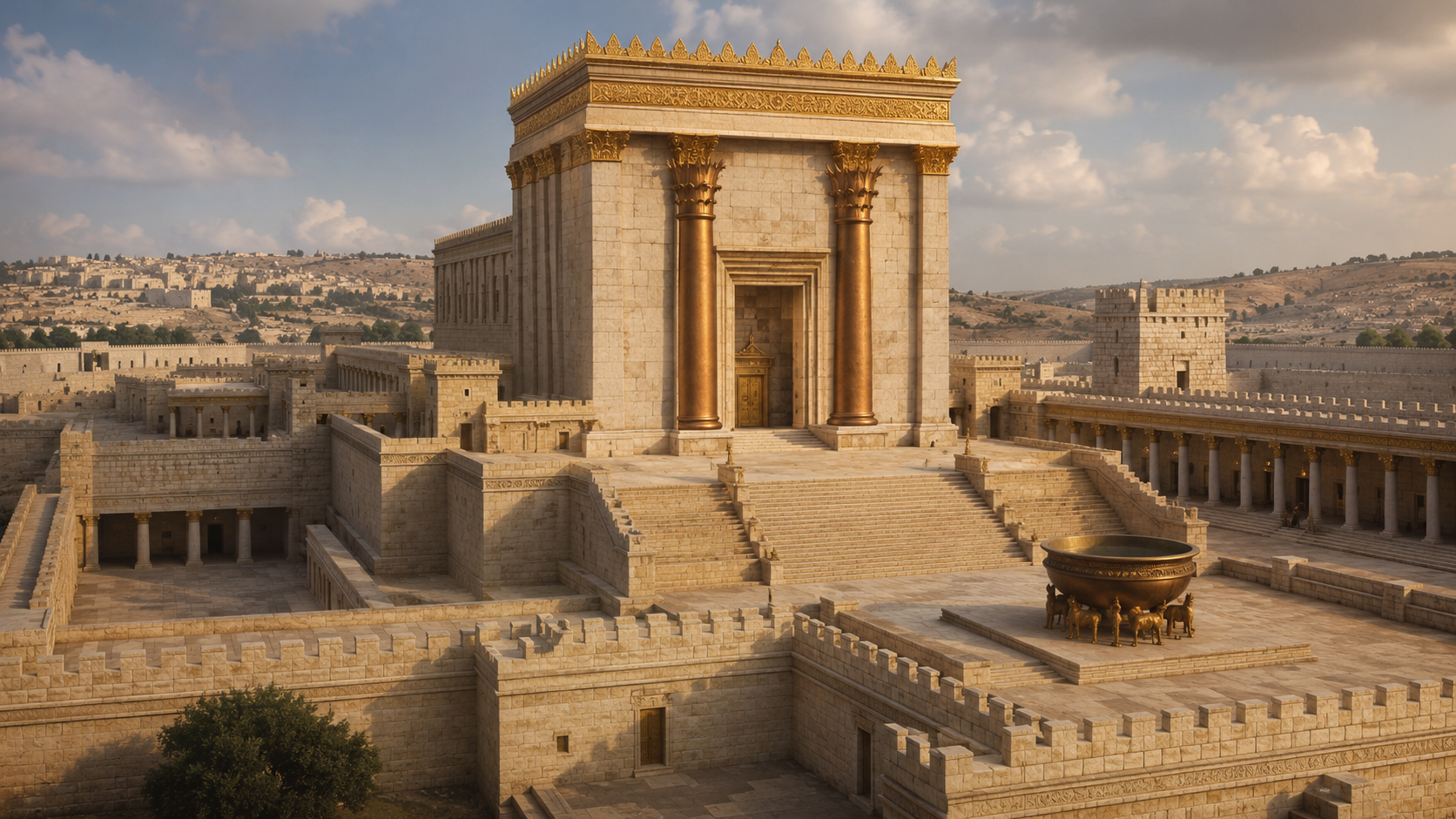
An Investigation into the Architecture of Creation, Solomon’s Temple, and the Masonic Lodge
Did Solomon Invent Sacred Architecture?
“Then David gave to Solomon his son the pattern … And the pattern of all that he had by the spirit.”
– 1 Chronicles 28:11-12 (KJV)
The Question Hidden in the Name
We call it Solomon’s Temple, and the name performs more intellectual work than we usually notice. It appears to identify a building by its author in the same way that a painting may be identified by its artist or a theorem by the mathematician who first proved it. Repetition then hardens the association. Solomon becomes not merely the king under whom the Temple was built but the originating mind from which its architecture emerged. The building appears as the material extension of one exceptional intelligence. Yet the biblical accounts themselves resist that conclusion almost from the moment the project is introduced. David conceives the desire to build; a divine promise assigns the work to a successor; an inherited sanctuary supplies its ritual grammar; the king of Tyre provides materials and technical cooperation; named craftsmen execute work that Solomon does not possess the skill to perform; labourers, administrators, priests, and an entire political economy make construction possible. Solomon remains indispensable, but he is never alone. The familiar name compresses a network of mandate, memory, craft, diplomacy, labour, and theological interpretation into the reputation of one ruler. 1
This compression is not unique to the Temple. Civilisations routinely attach collective works to a sovereign, founder, or patron. We speak of a king’s palace, an emperor’s road, an architect’s cathedral, or a president’s reform, even when thousands of people supplied the design, knowledge, finance, administration, labour, correction, and continuity without which the achievement could not exist. Such naming is not necessarily false; it identifies the person who authorised, coordinated, or embodied the project. It becomes misleading only when patronage is mistaken for solitary invention. The distinction is especially important in sacred architecture because claims of personal originality can conflict with the very source of legitimacy the building asserts. A sanctuary presented as arising from revelation, covenant, inherited pattern, and communal obligation cannot simultaneously be treated as the unrestricted creation of a royal imagination. If the Temple is sacred because it conforms to an order greater than Solomon, then Solomon’s greatness cannot consist in replacing that order with himself.
The modern cult of originality makes this difficult to perceive. Contemporary culture often celebrates the creator who breaks with precedent, overturns established forms, and produces something recognisably his own. Ancient building traditions could esteem ingenuity, but they frequently located legitimacy elsewhere: in continuity with ancestral forms, restoration of an ancient plan, conformity to divine command, recovery of forgotten order, or successful embodiment of a received pattern. To build well was not necessarily to make the unprecedented. It could mean refusing arbitrary novelty. The builder’s wisdom was shown by knowing what must be preserved, what could be adapted, and how inherited principles could be given adequate form under new conditions. The question before us is therefore not whether Solomon contributed intelligence, judgment, administration, or vision. The evidence plainly presents him as the ruler who brought the project into monumental reality. The stricter question is whether the architecture itself originated with him.
A Building Conceived Before Solomon
That question must be answered through several types of evidence that should not be conflated with one another. The biblical texts make theological and historiographical claims about promise, pattern, wisdom, and construction. Archaeology seeks to determine the types of temples that existed in the Levant and what material comparisons are valid. Architectural analysis asks which forms were common, which were distinctive, and how function shaped design. Historical criticism asks how Kings and Chronicles differ in their accounts and what those differences disclose about later interpretation. Masonic reflection asks why English Craft Freemasonry adopted the Temple as a central allegory without turning that allegory into a claim of direct institutional descent from ancient Jerusalem. A serious investigation must permit these lines of evidence to converge where they genuinely support one another and remain distinct where certainty would otherwise be manufactured.
The Temple project begins before Solomon’s reign and, in the biblical narrative, before Solomon is named as its builder. David, settled in his house, observes that he inhabits a structure of cedar while the ark remains within curtains. The desire to build appears reasonable, even devout, and the prophet Nathan initially approves it. The divine oracle then reverses the direction of the proposal. David wishes to build a house for God; God reminds David that divine presence has moved with Israel without demanding a cedar house and promises instead to build David a house in the dynastic sense. Only after that reversal is a successor identified as the one who will build a house for the Divine Name. The sequence subordinates architecture to promise. The sanctuary is not authorised because the king experiences a private architectural ambition, and David’s good intention does not by itself establish competence or mandate. The project becomes legitimate only within an order that precedes the ruler who will execute it. 2
Chronicles intensifies this prior history. David gathers materials, organises personnel, charges Solomon, assigns divisions of service, and finally gives his son what the Authorized Version calls ‘the pattern’ of the porch, houses, treasuries, upper chambers, inner rooms, mercy-seat, courts, priestly divisions, vessels, and other works. The text adds that David possessed this pattern ‘by the spirit’ and concludes with the difficult declaration that the Lord made him understand the works of the pattern ‘in writing by his hand upon me.’ Whatever precise interpretation is given to that language, Solomon is not presented as beginning with a blank surface. He receives a commission already furnished with a theological purpose, an institutional structure, prepared resources, and a prior design. His task is immense, but it is the task of execution under obligation rather than invention without constraint. 3
Kings and Chronicles should not be merged as though they were duplicate stenographic records. They belong to different historiographical settings and distribute emphasis differently. Kings gives Solomon a more direct role in diplomacy, labour organisation, building, dedication, and royal administration; Chronicles enlarges David’s preparation, heightens the continuity with Mosaic worship, and gives the Temple project a more explicitly transmitted pattern. Isaac Kalimi’s study of the biblical historiographies demonstrates how the Chronicler rewrites and reshapes the Solomon tradition rather than merely reproducing Kings. That difference matters because intellectual honesty requires us to identify theological interpretation as interpretation. Yet the difference does not restore a theory of autonomous Solomonic invention. In Kings, the project still arises from the promise to David, depends upon Tyrian cooperation, receives the ark from an older sanctuary tradition, and is judged by covenantal fidelity. In Chronicles, the denial of solitary authorship is even clearer. The two accounts disagree in emphasis while converging on the proposition that the Temple does not originate as a private artistic experiment by Solomon. 4
The prior commission also exposes a governance principle that sacred institutions often obscure once their buildings become impressive. Founders and patrons can appear larger than the mandate they received. Later memory may attribute to them what belonged to predecessors, communities, texts, inherited offices, and obligations that no individual created. The more magnificent the institution becomes, the easier it is for authority to be narrated backwards: because the leader completed the work, he is assumed to have originated its legitimacy. The Temple narrative moves in the opposite direction. Solomon’s authority to build is derivative. He is authorised because a promise precedes him, because the project is connected to covenantal history, and because his work is expected to conform to a received purpose. Completion does not create the mandate; the mandate judges the completion.
The Tent Inside the House
Behind the stone Temple stands a tent. This is not merely a chronological observation but an architectural and theological restraint. The Tabernacle narratives of Exodus establish a sanctuary, an ark, an altar, priestly service, graded access, sacred furnishings, appointed materials, and a pattern shown to Moses long before Solomon’s construction. When the Temple is dedicated, the ark is not invented for the new building; it is carried into it. The inner sanctuary receives an object whose meaning belongs to the exodus, Sinai, covenant, wilderness, and a mobile people. At the centre of royal monumentality lies a memory that the Divine presence travelled before Israel possessed a capital, a palace, or a permanent house. The Temple can therefore magnify the sanctuary tradition, but it cannot honestly claim to have originated it. 5
The relation between Tabernacle and Temple is neither identity nor rupture. The Temple is not a stone photocopy of the tent, and the texts do not provide modern construction drawings from which either structure can be reconstructed without interpretation. Nevertheless, the architectural grammar is recognisable. There is an exterior realm and an interior realm, an ordered route of approach, a main sacred chamber and a more restricted inner sanctum, an ark associated with covenantal testimony, cherubic imagery, altars, lampstands, tables, priestly service, and distinctions between ordinary access and appointed ministry. The Temple expands, monumentalises, multiplies, and fixes these elements within a royal city. Its materials become heavier, more durable, and more politically visible, but the deepest relations are inherited. Carol Meyers’ study of the Tabernacle’s movement from Sinai to Jerusalem and Victor Hurowitz’s analysis of the Jerusalem Temple both demonstrate that the sanctuary traditions must be read through continuity and transformation rather than through the fiction of a design appearing without ancestry. 6
Permanence nevertheless changes the institution. A tent can be dismantled when the camp moves; a stone Temple creates a centre around which pilgrimage, priesthood, economy, royal legitimacy, memory, and territorial identity accumulate. Mobility limits the sanctuary’s capacity to become indistinguishable from one political city. Monumentality intensifies that risk. The Temple’s permanence permits continuity across generations, but it also concentrates authority, resources, and interpretation. The transition from tent to house is therefore not only an architectural improvement. It is a constitutional transformation in the life of the community. The same sacred grammar now operates within a structure tied to monarchy, taxation, labour mobilisation, diplomacy, and a capital. What was once carried among the people becomes an institution to which the people must travel.
This is precisely why the tent remains conceptually present inside the house. The Temple’s inner meaning cannot be reduced to its cedar, stone, bronze, gold, height, or fame. Its centre continues to point backwards to the covenant and the journey. The house is new in material form but old in obligation. Solomon’s achievement lies partly in translating a portable sanctuary tradition into a permanent national architecture without allowing the monument, at least in the canonical ideal, to erase the history that authorised it. The project is therefore already an act of interpretation. It takes an inherited grammar and asks how that grammar should inhabit a different scale, political order, technology, landscape, and historical moment. That is creative work, but it is not an invention from nothing.
Tyre Enters the Story (Ancient City of Sour, Lebanon)
The arrival of Tyre destroys any remaining picture of the Temple as an isolated product of Israelite genius. Solomon enters correspondence with Hiram, king of Tyre, invokes Hiram’s previous relationship with David, requests cedar from Lebanon, and expressly acknowledges the superior expertise of Sidonian timber workers. Hiram supplies cedar and cypress, arranges maritime transport, and enters an exchange involving provisions and political agreement. A second Tyrian connection appears in the skilled bronze worker also called Hiram, or Huram in Chronicles, whose ancestry and technical competence place him across Israelite and Phoenician worlds. He fashions pillars, capitals, networks, pomegranates, the great basin, lavers, stands, vessels, and other objects central to the Temple complex. The biblical account does not hide foreign expertise at the heart of the national sanctuary; it names it. 7
This cooperation has sometimes been treated as an embarrassing concession, as though sacred authenticity would require every technique, material, and architectural idea to arise within a sealed Israelite culture. The text shows no such anxiety. Cedar grows in Lebanon. Maritime transport requires coastal capability. Monumental bronze work requires specialised knowledge. Wisdom, therefore, includes the recognition that a community may possess a legitimate mandate without possessing every skill required to realise it. The Temple emerges through a network of differentiated competence. The king who has been celebrated for wisdom does not prove that wisdom by pretending self-sufficiency; he identifies expertise, negotiates access to it, and integrates it into a larger purpose.
The existence of Tyrian involvement does not prove that Solomon simply copied a Phoenician temple. Cultural transmission is rarely so mechanical. Materials and techniques may cross borders while receiving new ritual functions; an architectural plan may be adapted without transferring the theology of another cult; craftsmen may execute forms specified by patrons while contributing methods learned elsewhere. Conversely, it would be equally artificial to insist that sacred meaning prevents all architectural borrowing. Buildings are made within technical traditions. Craftsmen carry habits, proportions, solutions, ornament, and structural knowledge from one commission to another. The Temple’s theological distinctiveness does not require architectural isolation, and regional architectural resemblance does not establish theological identity. Form and meaning interact, but they are not interchangeable.
Tyre therefore forces a more mature definition of authorship. Solomon’s work is not diminished because others knew what he did not know. It is clarified. The king’s role is synthetic: he connects promise to resources, inherited pattern to specialised labour, landlocked monarchy to maritime supply, Israelite covenantal claims to the material capabilities of the wider Levant. A leader may be genuinely responsible for a work without being the source of every component. Indeed, the attempt to monopolise credit can reveal less wisdom than the capacity to convene excellence. The biblical Temple is the product of ordered cooperation, and its story preserves enough detail to prevent the royal name from swallowing the craftsmen who made the architecture possible.
A Temple in a Family of Temples
Archaeology introduces a necessary discipline of uncertainty. No secure remains of the First Temple have been excavated and identified on the Temple Mount, and the site’s religious and political sensitivity has severely limited the kind of direct investigation available at many other ancient locations. The biblical descriptions in Kings and Chronicles, therefore, remain the principal literary sources for reconstruction, but they are not neutral architectural specifications. They contain specialised terms whose meanings are debated, reflect different compositional histories, and describe a building that had already disappeared before the surviving texts reached their final forms. Fabio Porzia and Corinne Bonnet accordingly argue for a dialogue between textual and archaeological evidence that refuses both theological overconfidence and archaeological reductionism. Every modern plan of Solomon’s Temple is an argument assembled from texts, comparative buildings, linguistic judgment, and architectural probability. It is not a recovered photograph. 8
Comparative architecture nevertheless matters because the Temple described in 1 Kings does not stand outside the known building world of the ancient Levant. Scholars have long compared its longitudinal arrangement – an entrance porch, a principal hall, and a more restricted inner shrine – with temples at sites such as ‘Ain Dara in northern Syria and Tell Tayinat in southeastern Turkey. Side chambers, monumental entrances, decorated walls, raised sacred zones, and paired columns or column bases have also entered the comparison. John Monson described ‘Ain Dara as the closest known Solomonic parallel, while the Tell Tayinat temple has repeatedly been placed beside reconstructions of the Jerusalem plan. The Tayinat Archaeological Project itself notes that a temple uncovered there was famously compared with Solomon’s Temple. These parallels do not establish a single blueprint travelling intact from one site to another, but they locate the biblical description within a recognisable regional family of sacred architecture. 9
Recent discoveries in Judah have complicated the discussion further. A tenth-century building model from Khirbet Qeiyafa and a ninth-century temple at Tel Motza have been used to illuminate architectural features and technical vocabulary in the descriptions of Solomon’s palace and Temple. Yosef Garfinkel and Madeleine Mumcuoglu argue that these discoveries alter a debate in which some scholars had doubted whether a monumental Temple could have existed in Jerusalem in the tenth century BCE. David Shapira, however, criticises several common comparisons with ‘Ain Dara and argues that the Motza temple supplies a more relevant architectural analogue for particular features. The disagreement is valuable. It shows that archaeology does not deliver one uncontested Solomonic reconstruction; it supplies a field of constrained possibilities, competing analogues, and questions that expose where earlier certainty exceeded the evidence. 10
The details matter because popular reconstructions often turn hypotheses into apparent facts. Were the two named pillars freestanding monuments or structural supports? Was the porch roofed or open? Was the inner shrine a separate cube-like chamber constructed within the main hall, or a screened and elevated zone? How should the windows, side structures, carved motifs, and proportions be understood? Scholars have answered these questions differently by appealing to different analogues. ‘Ain Dara may illuminate one feature while differing sharply in another. Tell Tayinat may share a broad plan while belonging to a later political and architectural context. Motza may demonstrate a local temple tradition while remaining smaller and chronologically distinct. Similarity must therefore be measured feature by feature rather than announced wholesale. 11
The archaeological evidence supports a conclusion more disciplined than either triumphalism or scepticism. It does not permit us to claim that Solomon invented an unprecedented sacred form unknown to his world. The broad architectural type belonged to the Levant. Nor does regional similarity prove that the biblical Temple is fictional, derivative in every respect, or theologically indistinguishable from neighbouring sanctuaries. A building can participate in a shared architectural language while making a distinctive statement through its contents, rituals, authorised relationships, and interpretation. The Temple’s historical plausibility is strengthened by belonging to an architectural world; its meaning is not exhausted by that belonging. The question is no longer whether influence existed, but how inherited forms were reordered.
The Pattern and the Problem of Originality
The word ‘pattern’ now returns with greater force. Exodus repeatedly instructs Moses to make the Tabernacle and its furnishings according to the pattern shown on the mountain. Chronicles applies comparable language to the Temple material transmitted by David. The underlying Hebrew term can denote a form, model, likeness, or plan; it need not imply a modern set of dimensioned blueprints. The text itself does not preserve a document from which contemporary architects could reproduce the structure without interpretive choices. The theological claim is nevertheless clear: the sanctuary is answerable to a prior order. Its legitimacy does not arise merely from the builder’s taste, royal power, or technical ability. 12
This distinction must be protected from two opposite errors. The first is to turn ‘pattern’ into an occult technical code whose lost measurements supposedly unlock cosmic secrets unavailable to ordinary scholarship. Nothing in the evidence justifies that inflation. The second is to flatten the term until it means little more than a rough idea. The narratives devote sustained attention to arrangement, material, function, craftsmanship, access, and transmission. Pattern signifies constraint. It declares that not every possible design would serve the same purpose. Even when adaptation is required, the builder remains accountable to relationships that he did not author.
Ancient Near Eastern temple-building accounts help explain why fidelity could be more prestigious than novelty. Victor Hurowitz’s comparative work demonstrates that biblical narratives share literary features with Mesopotamian and Northwest Semitic accounts: divine prompting or approval, royal preparation, acquisition of materials, organisation of labour, construction, furnishing, dedication, prayer, blessing, and celebration. Ancient rulers could present themselves as restorers of sanctuaries, discoverers of ancient foundations, or faithful executors of divine intention. Such conventions do not make the biblical account a meaningless imitation; they show that the public grammar of legitimate building was already established. A king demonstrated greatness by placing his work within a sanctioned cosmic, ancestral, and political order. 13
Modern originality often means visible separation from predecessors. Sacred originality may mean the capacity to reveal an old order under new conditions without betraying it. On that definition, Solomon’s Temple can be creative without being invented. Its permanence, scale, urban setting, royal association, technical complexity, and national centrality distinguish it from the wilderness tent. Its specific synthesis of inherited sanctuary, Davidic promise, covenantal memory, Tyrian craft, and Jerusalem’s political geography is new. Yet its newness is the newness of translation. Translation is not passive copying. It requires judgment about equivalence, emphasis, loss, adaptation, and fidelity. The translator must understand both the source and the world into which the source is being carried. Solomon’s architectural wisdom, if the texts are read on their own terms, lies precisely there.
Wisdom Becomes Architecture
The Temple account is preceded by narratives of Solomon’s wisdom, and the placement is not accidental. His request is not for private wealth or victory but for an understanding heart capable of judging the people and discerning between good and bad. The wisdom subsequently attributed to him encompasses judgment, administration, knowledge, speech, international reputation, and the capacity to order a kingdom. Construction is one manifestation of that ordering intelligence. A monumental sanctuary cannot be produced by inspiration alone. It requires schedules, contracts, measurements, supply chains, technical supervision, allocation of labour, dispute resolution, ritual coordination, and long-term maintenance. Architecture is wisdom subjected to matter and time. 14
This helps explain why the Temple becomes inseparable from governance. The project coordinates forest, quarry, port, road, workshop, treasury, palace, priesthood, and workforce. It converts diplomatic relations into material supply and administrative authority into physical form. The building, therefore, reveals the structure of the regime that produces it. Every major institution does. Budgets disclose priorities; labour systems disclose whose burden is considered expendable; procurement reveals relationships of dependence; access rules expose hierarchy; official narratives determine whose contribution is remembered. Sacred purpose cannot remove these questions because sacred construction is still construction carried out by human authority.
The biblical record does not allow the splendour of Solomon’s building programme to conceal its cost. Kings describes levies, forced labour, administrative districts, payments, and extensive royal works. After Solomon’s death, the northern tribes complain to Rehoboam that his father made their yoke grievous and ask for relief. The kingdom’s division follows the refusal to lighten that burden. The same reign remembered for wisdom and Temple building, therefore, contains an institutional warning: an ordered building can emerge from a political process experienced as oppressive. Magnificence is not self-validating. The beauty of the outcome cannot by itself settle the justice of the means. 15
This tension is essential to the present investigation. If Solomon’s greatness consisted simply in inventing a spectacular form, the building’s appearance could dominate the moral judgment. If his role was instead to execute a received sacred order, then the process of execution must itself be tested against that order. A Temple devoted to covenant cannot be exempt from covenantal scrutiny in the treatment of labour, neighbour, stranger, debtor, or subject. Architecture may embody order visually while the institution producing it generates disorder socially. The prophets will later make precisely this accusation against those who trust sacred forms while violating the obligations that give those forms meaning. The true pattern must therefore govern not only dimensions but conduct.
What Made the Temple Distinctive?
If Solomon did not invent the broad architectural type, what made the Jerusalem Temple distinctive? The answer cannot rest safely upon the claim that every visible feature was unique. The regional evidence will not sustain it. Distinctiveness lies instead in the configuration of relationships established by the canonical account. The house is built for the Divine Name; the ark associated with covenantal testimony occupies the inner sanctuary; cherubim frame the invisible throne-space; prayer is directed toward the house while the God addressed is asked to hear from heaven; the foreigner is included within the horizon of the dedication; and the entire institution remains subject to prophetic judgment. The canonical description does not place a sculpted anthropomorphic image of YHWH at the centre. The focal arrangement is presence without containment, kingship without an ordinary cult statue, and architecture ordered around covenantal memory. 16
Historical caution remains necessary. Archaeology and the biblical texts indicate that Israelite and Judahite religion developed through contested practices, local sanctuaries, images, reforms, and theological arguments. The canonical ideal should not be projected backwards as a complete description of everything ancient Israelites believed or did. Scholarship on Israelite aniconism has shown that the absence of a divine statue in the Jerusalem tradition must be analysed within a wider ancient Near Eastern context and cannot be reduced to a simple claim that Israel possessed no material representation of divine presence. The ark, cherubim, standing stones, symbols, and sacred objects complicate that picture. Our argument is narrower: in the literary architecture that became authoritative, the inner sanctuary is organised to resist the identification of God with a manufactured human form. 17
This reveals how a shared architectural language can be transformed. A porch is not Israelite or Phoenician by nature. A long room, inner chamber, column, basin, carved palm, chain, pomegranate, or cherub acquires meaning through placement, relation, authorised use, and interpretation. The same technical vocabulary can serve different theological and political grammars. Language itself works this way: communities use many of the same words but form different propositions with them. Sacred architecture is likewise syntactical. Its originality may lie less in inventing every element than in arranging inherited elements so that they say something they did not say in precisely that way elsewhere.
The Temple’s distinctiveness is therefore relational rather than isolated. Creation supplies the conviction that order precedes human building. The Tabernacle supplies the sanctuary grammar and covenantal centre. Davidic tradition supplies promise and dynastic commission. Jerusalem supplies place. Tyre supplies materials and specialised craft. Levantine architecture supplies available forms and structural solutions. Solomon’s administration supplies coordination and monumental execution. Priestly service supplies continuity of use. Prophetic criticism supplies the test by which the institution may be judged. Remove any one of these and the Temple becomes a different proposition. Its identity arises from their ordered convergence.
Could Solomon Still Be Called the Builder?
The conclusion that Solomon did not invent sacred architecture does not require us to deny the biblical statement that he built the Temple. Ancient royal language routinely attributes great works to the ruler who commissions, finances, organises, and assumes public responsibility for them. We continue to speak in the same way. A government builds a bridge, though no abstract government pours concrete; an architect builds a museum, though contractors and trades execute the work; a founder builds an organisation, though the institution depends upon generations of colleagues. Causative authorship is real. It becomes deceptive only when it erases the prior mandate and collective agency that make the work possible.
The Temple narrative distributes those forms of agency with unusual richness. David desires, prepares, and transmits. Solomon receives, judges, negotiates, levies, organises, commissions, and dedicates. Hiram of Tyre supplies materials and a diplomatic partnership. Sidonian workers cut timber. Quarrymen shape stone. The bronze craftsman Hiram executes technically demanding furnishings. Israelite and non-Israelite labourers transport and assemble. Priests and Levites establish liturgical use. The people contribute resources and bear burdens. The sacred texts provide purpose and memory. God, within the theological account, authorises, fills, hears, warns, and judges. ‘Solomon built’ is therefore a valid summary of responsibility, not a complete description of causation.
This broader account protects two truths that founder narratives often separate. The first is that great leadership can genuinely integrate capacities that would otherwise remain dispersed. Without Solomon, the received project may not have become the Temple described. Coordination is not clerical. It requires choice, timing, authority, risk, and accountability. The second truth is that integration does not convert every contribution into the intellectual property of the leader. A ruler who receives a mandate cannot claim to have created the mandate; a patron who commissions expertise cannot claim to possess the craft; an institution that preserves inherited symbols cannot claim ownership of the realities to which they point.
Solomon may therefore be called the builder in a more demanding sense than the word inventor allows. The inventor is imagined as beginning with himself. The builder begins with conditions he did not choose: ground, material, law, measure, inherited purpose, available skill, human limitation, and consequences. He is judged not merely by novelty but by whether the structure stands, serves its purpose, preserves what must be preserved, and does justice to those whose labour it contains. Solomon’s exemplary role lies in translating a prior order into durable form. His tragic warning lies in the possibility that the political machinery used to build order in stone may generate disorder among people.
The Masonic Consequence
English Craft Freemasonry does not need Solomon to have invented sacred architecture. Its public explanations describe Freemasonry as using building analogies to teach members how to lead constructive lives, while the Museum of Freemasonry presents tracing boards as visual instruments through which the building of character is contemplated. Quatuor Coronati Lodge’s notice for the 2026 Prestonian Lecture states that the building of King Solomon’s Temple has been one of the central allegories of the Craft degrees as worked in England and Wales since the eighteenth century. The value of that allegory lies in moral and intellectual architecture, not in proving that every Temple form was unprecedented or that modern Freemasonry descends institutionally from Solomon’s workforce. 18
The historical distinction is indispensable. Serious scholarship on the emergence of modern Freemasonry traces operative traditions, early modern lodges, catechisms, constitutional developments, ritual formation, and the growth of speculative building allegory. It does not provide evidence of an unbroken corporate succession from the builders of the Jerusalem Temple to lodges under the United Grand Lodge of England. Legendary history and symbolic lineage perform different functions from documentary history. To confuse them weakens both. The historical claim becomes indefensible, while the allegory is burdened with a proof it does not require. 19
Once that confusion is removed, the result is more profound. The Temple becomes Masonic not because it was architecturally isolated from its world, but because it embodies the discipline of building under a rule greater than personal preference. The speculative Mason receives tools, obligations, relationships, inherited forms, and a task of moral construction. He is not invited to invent good and evil according to appetite. He is invited to work upon material already given – character, circumstance, duty, weakness, community, time – and to bring it into better order. The model is not autonomous creativity but responsible workmanship.
The collaborative authorship of the Temple also corrects the vanity that can enter any institution devoted to hierarchy, office, and tradition. No Master builds alone. Authority may coordinate the work, but it depends upon craftsmen, officers, teachers, candidates, predecessors, records, rules, and brethren whose labour may be less visible than the chair from which direction is given. To attribute everything to the presiding figure is to misunderstand the architecture of a lodge as seriously as one would misunderstand the Temple by forgetting David, Hiram, the artisans, the priests, and the people. The true measure of mastery is not the accumulation of credit but the ordering of contributions toward a purpose no office-holder owns.
At the same time, this manuscript must preserve the clear line maintained by the United Grand Lodge of England between Freemasonry and religion. The biblical Temple may be examined historically, architecturally, philosophically, and symbolically within a Masonic presentation, but an interpretive theory concerning revelation, cosmic order, or divine architecture must not be announced as official English Craft doctrine. UGLE describes Freemasonry as non-religious and cautions against practices that blur that distinction. What is offered here is an investigation: disciplined reading placed before the conscience, not a creed imposed upon it. 20
The Answer and the Next Question
Did Solomon invent sacred architecture? In the strict modern sense, the answer is no. The biblical narratives do not present him as creating the Temple from an empty intellectual field. The project precedes him in Davidic promise and preparation; the sanctuary grammar precedes him in the Tabernacle; the claim of pattern places the design under prior authority; Tyrian partnership supplies materials and expertise; regional temples demonstrate that the broad architectural language belonged to the ancient Levant; and collective labour turns commission into stone, timber, bronze, gold, ritual, and institution. Archaeology cannot recover every detail of the Jerusalem building, but nothing in the available evidence requires the hypothesis of a form without ancestry.
Yet the negative answer should not be mistaken for a reduction of Solomon’s achievement. He did something more difficult than merely imagining novelty. He translated. He received an inherited sacred order and gave it permanent political, architectural, and national form. He joined traditions that could have remained separate: wilderness sanctuary and royal capital, covenantal memory and monumental craft, Israelite purpose and Phoenician skill, invisible presence and visible institution. The Temple became new through synthesis, scale, location, and ordered relationship. Solomon’s wisdom was not the wisdom of beginning without predecessors; it was the wisdom of making predecessors speak within a structure capable of outliving him.
That conclusion now exposes the next problem. If the Temple was governed by a pattern and not by unrestricted invention, how much freedom did its builder possess? Which features belonged to the essence of the institution, and which were historical adaptations to material, technology, culture, politics, and place? Could the Temple have been circular rather than longitudinal, placed elsewhere, entered differently, furnished otherwise, or built without the relationships preserved in the texts – and still have remained the same Temple? To ask whether Solomon invented sacred architecture was to uncover a deeper question about necessity and contingency. Investigation Four must therefore ask: Could the Temple Have Been Designed Differently?
Notes and References
1. The Holy Bible, Authorized King James Version, 1 Kings 5-8; 1 Chronicles 22 and 28; 2 Chronicles 2-7. These texts distribute the Temple project among divine promise, Davidic preparation, Solomonic government, Tyrian cooperation, specialised craft, labour, priestly service, and dedication.
2. The Holy Bible, KJV, 2 Samuel 7:1-17; compare 1 Chronicles 17:1-15. David’s proposal is subordinated to the divine promise that a successor will build a house for the Divine Name.
3. The Holy Bible, KJV, 1 Chronicles 22:2-19; 28:1-21, especially 28:11-12 and 28:19. The Authorized Version uses ‘pattern’ for the transmitted plan and describes David as understanding the works through divine writing or agency.
4. Isaac Kalimi, Writing and Rewriting the Story of Solomon in Ancient Israel (Cambridge: Cambridge University Press, 2018), especially 272-295, doi:10.1017/9781108558235.014. Kalimi analyses the distinct presentations of Solomon’s Temple building and divine approval in biblical historiographies.
5. The Holy Bible, KJV, Exodus 25-40; 1 Kings 8:1-11; 2 Chronicles 5:1-14. The Temple receives the ark and sanctuary tradition rather than originating them.
6. Carol Meyers, ‘The Biblical Tabernacle: From Sinai to Jerusalem,’ in Jewish Religious Architecture: From Biblical Israel to Modern Judaism, ed. Steven Fine (Leiden: Brill, 2019), 7-22; Victor Avigdor Hurowitz, ‘The Temple of Jerusalem in Biblical Israel,’ in the same volume, 23-50. Both studies situate the Temple within inherited sanctuary traditions and wider architectural contexts.
7. The Holy Bible, KJV, 1 Kings 5:1-18; 7:13-47; 2 Chronicles 2:1-16; 4:11-18. The accounts explicitly credit Hiram of Tyre, Sidonian expertise, Lebanese timber, maritime transport, and the bronze craftsman Hiram or Huram.
8. Fabio Porzia and Corinne Bonnet, ‘The Jerusalem Temple Between “Theology” and Archaeology: Which Issues, What Dialogue?’ Palethnologie 9 (2017): 31-51, doi:10.4000/palethnologie.336. The article stresses the need to hold textual, archaeological, and historical questions together and notes the limitations of direct evidence for the First Temple.
9. John M. Monson, ‘The New ‘Ain Dara Temple: Closest Solomonic Parallel,’ Biblical Archaeology Review 26, no. 3 (2000): 20-35; Tayinat Archaeological Project, University of Toronto, project overview and Temple XVI materials, accessed 30 July 2026. The comparisons concern a regional long-room temple tradition and particular architectural features, not proof of direct copying.
10. Yosef Garfinkel and Madeleine Mumcuoglu, ‘The Temple of Solomon in Iron Age Context,’ Religions 10, no. 3 (2019): article 198, doi:10.3390/rel10030198; David Shapira, ‘The Moza Temple and Solomon’s Temple,’ Bibliotheca Orientalis 75, nos. 1-2 (2018): 25-48. These works illustrate both the contribution of newer Judean discoveries and continuing disagreement over the strongest architectural analogues.
11. Shapira, ‘The Moza Temple and Solomon’s Temple’; Monson, ‘The New ‘Ain Dara Temple’; Timothy P. Harrison, ‘West Syrian Megaron or Neo-Assyrian Langraum? The Shifting Form and Function of the Tell Tayinat (Kunulua) Temples,’ in Temple Building and Temple Cult, ed. Jens Kamlah (Wiesbaden: Harrassowitz, 2012), 3-21. The reconstruction of pillars, porch, shrine, side structures, and other features remains debated.
12. The Holy Bible, KJV, Exodus 25:9, 40; 26:30; 1 Chronicles 28:11-19. On the range of the Hebrew term tabnit as form, likeness, model, or pattern, see Ludwig Koehler, Walter Baumgartner, and Johann Jakob Stamm, The Hebrew and Aramaic Lexicon of the Old Testament (Leiden: Brill, 1994-2000), s.v. ‘tabnit.’
13. Victor Avigdor Hurowitz, I Have Built You an Exalted House: Temple Building in the Bible in Light of Mesopotamian and Northwest Semitic Writings, JSOT Supplement Series 115 (Sheffield: Sheffield Academic Press, 1992). Hurowitz demonstrates extensive structural and literary parallels among ancient Near Eastern temple-building accounts while analysing the distinctive adaptation of those conventions in the biblical narratives.
14. The Holy Bible, KJV, 1 Kings 3:3-28; 4:1-34; 5:1-18. Solomon’s wisdom is connected to judgment, administration, knowledge, international reputation, diplomacy, and the organisation of construction.
15. The Holy Bible, KJV, 1 Kings 5:13-18; 9:15-23; 11:26-28; 12:1-19. The narratives connect Solomon’s building system to levies and labour burdens later invoked in the political rupture under Rehoboam. See Keith Bodner, The Theology of the Book of Kings (Cambridge: Cambridge University Press, 2019), 52-79 and 107-125.
16. The Holy Bible, KJV, 1 Kings 6:19-35; 8:6-30, 41-43. See Jon D. Levenson, ‘The Temple and the World,’ The Journal of Religion 64, no. 3 (1984): 275-298, doi:10.1086/487131; Hurowitz, ‘The Temple of Jerusalem in Biblical Israel.’
17. Tryggve N. D. Mettinger, No Graven Image? Israelite Aniconism in Its Ancient Near Eastern Context (Stockholm: Almqvist & Wiksell International, 1995). Mettinger distinguishes aniconism from the absence of all sacred material representation and situates Israelite practice within its regional context.
18. United Grand Lodge of England, ‘What Is Freemasonry?’ accessed 30 July 2026; Museum of Freemasonry, ‘Tour Highlights,’ accessed 30 July 2026; Quatuor Coronati Lodge No. 2076, ‘Solomon’s Temple in Myth & Ritual: The 2026 Prestonian Lecture,’ meeting notice for 10 September 2026, accessed 30 July 2026. The QC notice describes the building of King Solomon’s Temple as a central allegory of the Craft degrees in England and Wales since the eighteenth century.
19. John Hamill, The Craft: A History of English Freemasonry (Wellingborough: Crucible, 1986); David Stevenson, The Origins of Freemasonry: Scotland’s Century, 1590-1710 (Cambridge: Cambridge University Press, 1988); Douglas Knoop, G. P. Jones, and Douglas Hamer, The Early Masonic Catechisms, 2nd ed. (Manchester: Manchester University Press, 1963). These works support a historically differentiated account of operative inheritance, early lodges, ritual development, and legendary history rather than an unbroken institutional chain from ancient Jerusalem.
20. United Grand Lodge of England, Information for the Guidance of Members of the Craft (London: UGLE, 2024), 44; United Grand Lodge of England, ‘What Is Freemasonry?’ and ‘Freemasonry FAQs,’ accessed 30 July 2026. UGLE states that Freemasonry is not a religion and cautions against blurring the distinction between Masonic practice and religion.
Selected Bibliography
The Holy Bible. Authorized King James Version.
Bodner, Keith. The Theology of the Book of Kings. Cambridge: Cambridge University Press, 2019.
Garfinkel, Yosef, and Madeleine Mumcuoglu. ‘The Temple of Solomon in Iron Age Context.’ Religions 10, no. 3 (2019): article 198.
Hamill, John. The Craft: A History of English Freemasonry. Wellingborough: Crucible, 1986.
Harrison, Timothy P. ‘West Syrian Megaron or Neo-Assyrian Langraum? The Shifting Form and Function of the Tell Tayinat (Kunulua) Temples.’ In Temple Building and Temple Cult, edited by Jens Kamlah, 3-21. Wiesbaden: Harrassowitz, 2012.
Hurowitz, Victor Avigdor. I Have Built You an Exalted House: Temple Building in the Bible in Light of Mesopotamian and Northwest Semitic Writings. JSOT Supplement Series 115. Sheffield: Sheffield Academic Press, 1992.
Hurowitz, Victor Avigdor. ‘The Temple of Jerusalem in Biblical Israel.’ In Jewish Religious Architecture: From Biblical Israel to Modern Judaism, edited by Steven Fine, 23-50. Leiden: Brill, 2019.
Kalimi, Isaac. Writing and Rewriting the Story of Solomon in Ancient Israel. Cambridge: Cambridge University Press, 2018.
Knoop, Douglas, G. P. Jones, and Douglas Hamer. The Early Masonic Catechisms. 2nd ed. Manchester: Manchester University Press, 1963.
Koehler, Ludwig, Walter Baumgartner, and Johann Jakob Stamm. The Hebrew and Aramaic Lexicon of the Old Testament. Leiden: Brill, 1994-2000.
Levenson, Jon D. ‘The Temple and the World.’ The Journal of Religion 64, no. 3 (1984): 275-298.
Mettinger, Tryggve N. D. No Graven Image? Israelite Aniconism in Its Ancient Near Eastern Context. Stockholm: Almqvist & Wiksell International, 1995.
Meyers, Carol. ‘The Biblical Tabernacle: From Sinai to Jerusalem.’ In Jewish Religious Architecture: From Biblical Israel to Modern Judaism, edited by Steven Fine, 7-22. Leiden: Brill, 2019.
Monson, John M. ‘The New ‘Ain Dara Temple: Closest Solomonic Parallel.’ Biblical Archaeology Review 26, no. 3 (2000): 20-35.
Museum of Freemasonry. ‘Tour Highlights.’ Accessed 30 July 2026.
Porzia, Fabio, and Corinne Bonnet. ‘The Jerusalem Temple Between “Theology” and Archaeology: Which Issues, What Dialogue?’ Palethnologie 9 (2017): 31-51.
Quatuor Coronati Lodge No. 2076. ‘Solomon’s Temple in Myth & Ritual: The 2026 Prestonian Lecture.’ Accessed 30 July 2026.
Shapira, David. ‘The Moza Temple and Solomon’s Temple.’ Bibliotheca Orientalis 75, nos. 1-2 (2018): 25-48.
Stevenson, David. The Origins of Freemasonry: Scotland’s Century, 1590-1710. Cambridge: Cambridge University Press, 1988.
Tayinat Archaeological Project. University of Toronto. Accessed 30 July 2026.
United Grand Lodge of England. Information for the Guidance of Members of the Craft. London: UGLE, 2024.
United Grand Lodge of England. ‘Freemasonry FAQs.’ Accessed 30 July 2026.
United Grand Lodge of England. ‘What Is Freemasonry?’ Accessed 30 July 2026.
Leave a Reply