



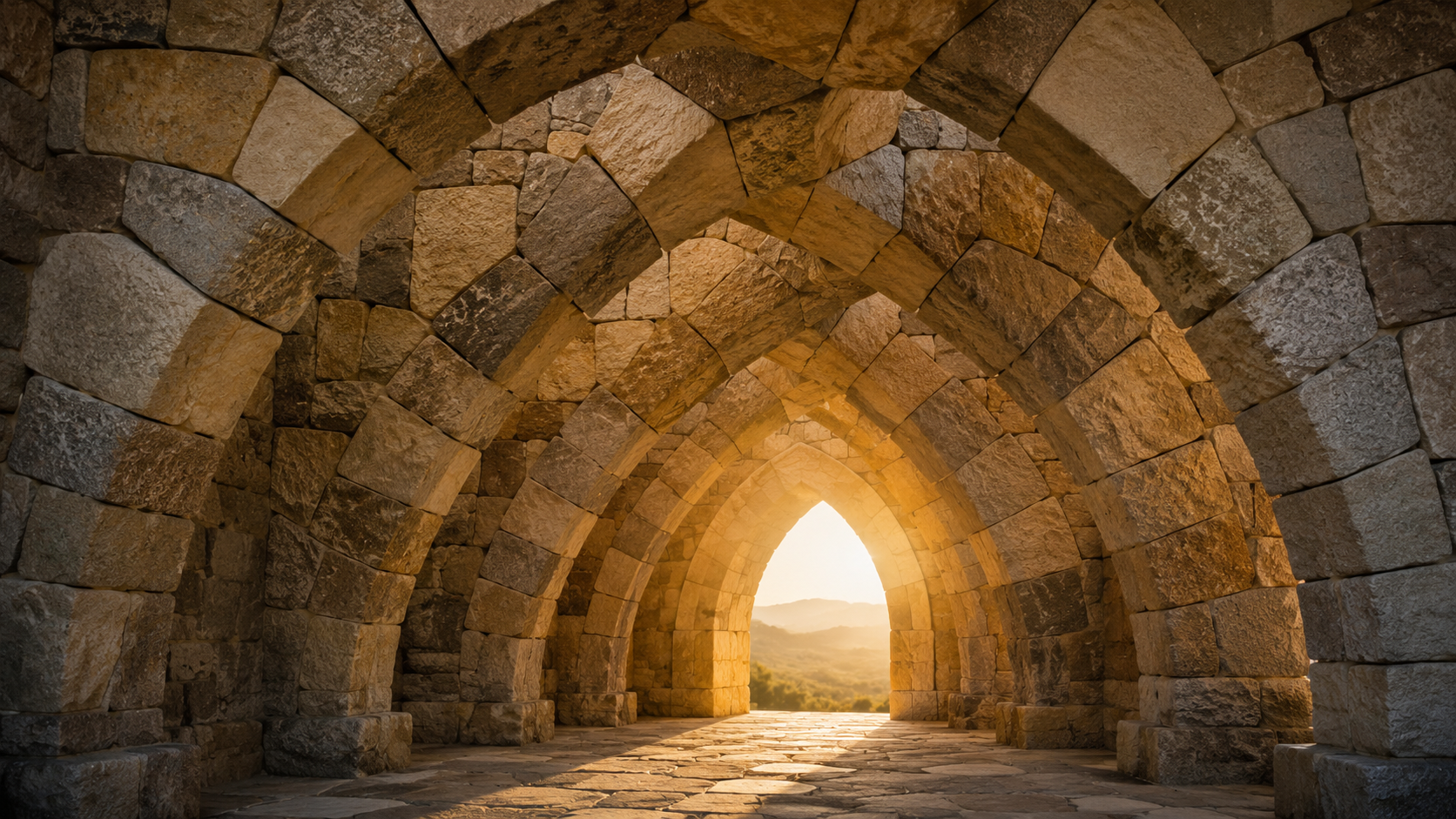
What Existed Before the Temple?
“How dreadful is this place! this is none other but the house of God, and this is the gate of heaven.”
– Genesis 28:17 (KJV)
The House That Came Late
Solomon’s Temple dominates the imagination so completely that it is easy to mistake prominence for origin. In the biblical narrative it becomes the visible centre of a kingdom, the place of dedication, sacrifice, royal prayer, national assembly, priestly service, and later prophetic judgment. In Masonic memory it becomes more concentrated still: the building is not merely one sanctuary among others but the great architectural setting within which labour, order, fidelity, loss, and recovery can be contemplated. Yet the Temple appears late. Before Solomon laid a foundation, generations had already encountered the Divine, raised altars, made vows, received law, distinguished holy from common, carried the Ark, served at a sanctuary, and organised communal life around covenantal obligations. The house was monumental, but the sacred grammar it embodied was older than its stone. 1
This chronological fact creates a conceptual problem. If sacred order began with the Temple, then the Temple could plausibly be treated as the source of the authority it exercised. If, however, the decisive elements of that order existed before it, the relationship is reversed. The Temple becomes an heir rather than an author, a trustee rather than a proprietor. Its magnificence cannot explain its mandate, because the mandate precedes the magnificence. Its custodians cannot claim that the sacred depends upon them, because the sacred had already judged, summoned, and ordered human beings before their institution existed. The question ‘What existed before the Temple?’ is therefore not an antiquarian request for a list of earlier shrines. It is a test of institutional genealogy: where did the authority embodied by the Temple come from, and what remained capable of judging the Temple after it had been built?
The answer cannot be reduced to a single predecessor. Before Solomon stood a sequence of forms: the altar erected after an encounter, the named place preserved by memory, the mountain ordered by boundaries and degrees of approach, the covenant ratified before a people, the portable sanctuary constructed according to a pattern, the Ark carried before any permanent house, and the national shrine at Shiloh that could be abandoned when its custodians corrupted their trust. Behind these forms stood more fundamental realities still: sacred time, divine command, the distinction between order and disorder, and the conviction that human building is legitimate only when it answers to an order it did not invent. 2
This investigation will therefore move backward. It will not search for a lost architectural prototype from which Solomon copied every dimension. It will reconstruct a genealogy of principles. The objective is to identify what the Temple received, what it concentrated, what it transformed, and what it never possessed the authority to create. The argument is that Solomon’s Temple constitutionalised a prior sacred order: it gathered dispersed memories, practices, boundaries, offices, symbols, and claims into a permanent national institution. That achievement was immense. But constitutional settlement is not creation ex nihilo. The institution came after the encounter; the house came after the command; the custodian came after the mandate.
Babel: The Monument Before the Mandate
Before the patriarchal altars, the primeval history has already shown that human beings can build with intelligence, coordination, and ambition. At Shinar they master a new material system – fired brick joined with bitumen – and convert technical capacity into a collective programme: ‘Go to, let us build us a city and a tower, whose top may reach unto heaven; and let us make us a name, lest we be scattered abroad upon the face of the whole earth.’ The project has labour, material, method, scale, unity, and a declared political objective. What it does not claim is an encounter to which the builders are responding, a covenant they have received, or a mandate whose limits they acknowledge. Its authority is self-issued: they will build, make a name, and secure themselves against dispersion. 3
Babel must be handled with interpretive discipline. The familiar reading treats the tower as a monument to pride and the scattering as punishment for human arrogance. Theodore Hiebert and others have challenged that consensus, arguing that the narrative is concerned more directly with the emergence of cultural and linguistic plurality than with an attempt to storm heaven. The text itself does not call the tower a temple, identify its height, or explicitly name pride as the offence. Yet the disagreement does not erase the architectural fact central to this investigation. The builders announce what the work is meant to achieve: a common name, a fixed centre, and protection against scattering. The narrative then denies the building the power to guarantee precisely those objectives. Monumental coordination proves unable to make its own social settlement permanent.
The canonical sequence sharpens the contrast. At Babel humanity says, ‘let us make us a name.’ In the next chapter, Abram is called away from country, kindred, and father’s house and receives the promise, ‘I will make of thee a great nation … and make thy name great.’ The juxtaposition distinguishes two architectures of legitimacy. One attempts to manufacture permanence through concentration, sameness, and a monument bearing the builders’ collective ambition; the other begins with summons, departure, promise, and an altar erected only after the word has been received. The issue is not whether brick is inferior to stone, whether cities are profane, or whether coordinated labour is suspect. It is whether construction answers to a mandate beyond the constructors or is expected to generate its own authority.
Babel therefore provides the necessary negative control for every sanctuary that follows. Technical order is not yet sacred order. A project may be geometrically sound, administratively coordinated, materially innovative, and socially impressive while remaining unable to justify the end it serves. Architecture can concentrate power as readily as it can discipline attention; it can make a community answerable to an inherited covenant, or make the community answerable only to the image it has built of itself. Before the Temple, then, there already existed both the capacity to build and the temptation to confuse building with legitimacy. The patriarchal altar enters the narrative on the other side of that warning: not ‘let us make’, but a human response to what has first been given.
Encounter Before Institution
The patriarchal narratives present worship before there is a central sanctuary, a hereditary priesthood, a national calendar, or a permanent sacred building. Abraham builds altars at Shechem and between Bethel and Ai after divine appearance and promise; he later settles by the oaks of Mamre and builds again. Isaac builds at Beersheba after reassurance. Jacob erects an altar at Shechem and returns to Bethel in fulfilment of an earlier vow. These acts are not described as casual religious improvisations, nor do they constitute a developed Temple system in miniature. They are responses. The initiative belongs to the encounter, promise, deliverance, guidance, or covenant that precedes the act of construction. The altar does not summon the event into existence; it marks an event that has already imposed meaning upon a place. 4
That distinction explains why the patriarchal altar is both modest and powerful. It has no walls, roof, inner chamber, royal treasury, or permanent administrative body. Its material form may be little more than arranged stone, yet it performs several functions later concentrated in sanctuary architecture. It separates a site from the undifferentiated landscape, binds memory to place, makes gratitude or obligation visible, and establishes a point to which descendants may return. The altar is thus architecture at its minimum: not a house, but an ordered relation among encounter, place, memory, offering, and human response. It demonstrates that sacred architecture does not begin when stone encloses space. It begins when a place is made accountable to an event whose meaning must not be forgotten.
The historical status of the patriarchal narratives remains debated. Scholars differ over their date, social setting, relationship to later Israelite religion, and value as evidence for second-millennium practice. A rigorous argument should not evade that dispute by treating every narrated detail as an independently verified archaeological report. Yet the present inquiry concerns first the architecture of the canonical narrative: how the biblical tradition itself constructs the genealogy of sacred order. Within that narrative, worship is deliberately represented as preceding the Temple, and the patriarchs are represented as acting without an established national cult. Augustine Pagolu’s study of patriarchal religion emphasises this relative informality: patriarchal worship is associated with theophany, migration, covenant, vow, and guidance rather than with a fixed sanctuary and permanent cultic personnel. 5
The point is not that informality is inherently purer than institution. Memory without form can disappear; personal encounter without communal discipline can become private invention; dispersed altars can become vehicles of rivalry or syncretism. The later movement toward sanctuary, priesthood, law, and centralisation answers genuine problems of continuity and accountability. Nevertheless, the sequence matters. Institution is introduced to preserve, regulate, and transmit a prior claim. It does not confer reality upon that claim. The altar before the Temple therefore establishes the first principle of our genealogy: sacred authority is responsive before it is administrative. Human beings build because they have been addressed; the building is not the author of the address.
Bethel: The House of God Without a House
The most disruptive pre-Temple episode occurs at Bethel. Jacob, fleeing the consequences of family conflict, stops at an unnamed place as the sun sets. He takes a stone for a pillow and sleeps. In the dream, earth and heaven are connected; divine speech renews promise, presence, and protection. On waking, Jacob does not admire a building, for there is none. He says, ‘Surely the LORD is in this place; and I knew it not,’ and then, in fear, ‘How dreadful is this place! this is none other but the house of God, and this is the gate of heaven.’ He raises the stone, pours oil upon it, names the place Bethel, and binds the memory to a vow. The narrative gives us a house of God before there is a house. 6
This language prevents a crude identification of sacred dwelling with enclosure. ‘House’ here cannot mean that masonry contains the Divine. It describes a place of access, disclosure, promise, and relation. The ‘gate of heaven’ is not constructed by Jacob; he recognises it. His action after the dream gives durability to recognition. The pillar and the name do not manufacture presence. They keep the event from dissolving into private memory. The sacred place emerges through a sequence that later architecture will formalise: encounter, awakening, fear, naming, marking, vow, and return. Bethel therefore supplies a prototype not of a floor plan but of a logic. A site becomes sacred when it is caught within a relation that exceeds the traveller who happened to sleep there.
The later history of Bethel also exposes the vulnerability of sacred memory. A place whose name recalls divine encounter becomes, under Jeroboam, a royal cult centre serving the political consolidation of the northern kingdom. Prophetic literature can therefore invoke Bethel both as ancestral memory and as an institution under judgment. The tension is instructive. Founding memory does not immunise later custody. A ruler may inherit a sacred name, occupy a sacred site, and deploy ancestral symbolism while reversing the relation that originally gave the place authority. The name ‘house of God’ can become a political instrument if the institution treats inherited memory as its own asset rather than as a standard by which it remains answerable. 7
Bethel thus contributes two principles to the genealogy before the Temple. First, sacred place may be recognised before it is architecturally enclosed. Secondly, institutional continuity cannot be established by name and location alone. The legitimacy of a sacred centre depends upon fidelity to the relation it claims to preserve. These principles will later become decisive at Shiloh and Jerusalem. For the moment, Bethel establishes something even more fundamental: human architecture is not the first threshold between heaven and earth. Before the builder creates a gate, the narrative imagines the world as already capable of becoming a gate when divine initiative discloses what ordinary perception had failed to see.
Sinai: Architecture Without Walls
Before Israel receives a sanctuary, it encounters holy ground. At the burning bush, Moses is commanded to remove his shoes because the place on which he stands is holy. No priest has consecrated it, no ruler has selected it, and no permanent object marks it. Its holiness is relational and immediate: divine presence and command transform the moral conditions of approach. The episode is brief, but it establishes a principle that the later sanctuary never repeals. Holiness is not an inherent property possessed by stone or soil and transferable at will by human authorities. It is a condition in which ordinary access is interrupted because the person approaching has come under a claim greater than his own intention. 8
At Sinai this interruption becomes an ordered public system. Exodus 19-24 describes preparation, washing, appointed time, a boundary around the mountain, prohibition against unauthorised ascent, thunder, cloud, fire, voice, sacrifice, covenant, and differentiated access. The people stand below; appointed representatives ascend part of the way; Moses enters further into the cloud. An altar and pillars are erected at the base, and covenantal words are read and ratified. The mountain has no built walls, yet it possesses an unmistakable architecture. There is an outer assembly, a guarded boundary, degrees of nearness, authorised mediation, a summit associated with divine manifestation, and a sequence by which approach becomes possible without becoming possession. 9
To call this architecture is not to claim that Sinai was a Temple disguised as a mountain. The historical and literary identities of mountain and sanctuary must remain distinct. Architecture here refers to ordered relations rather than construction materials. Sinai shows that a sacred plan can be enacted through topography, boundary, role, time, and movement before it is translated into timber, textile, bronze, or stone. The mountain becomes an organised field of access. It disciplines curiosity, protects the community from unprepared approach, limits the mediator as well as the multitude, and subordinates every participant to a word received rather than invented. Jon Levenson and later scholarship have shown how Sinai and Zion function as major symbolic centres in the Hebrew Bible, while L. Michael Morales has developed the relationship between sacred mountain traditions and the later Tabernacle. 10
Sinai therefore adds another layer to the pre-Temple grammar. Sacred order requires more than a meaningful place; it requires a protocol of approach. Boundary is not merely exclusion. Properly understood, it makes relation sustainable by distinguishing invitation from seizure, office from ownership, and nearness from control. The one permitted to ascend does not become author of the mountain, and the people who covenant at its base do not convert revelation into their property. Authority is distributed, but no participant is sovereign over the encounter. The mountain is the first great institutional stress test of sacred access: who may approach, by what warrant, under what preparation, and for whose benefit?
From Mountain to Tent: The Portable Centre
Israel cannot remain at Sinai. A revelation fixed permanently to one mountain would leave a travelling people with a memory but no continuing centre. The Tabernacle answers this problem by translating encounter into portable order. The instructions for its construction follow the covenantal scenes at Sinai; the glory that rests upon the mountain later fills the completed dwelling. The narrative carefully links command and execution, pattern and craftsmanship, divine initiative and human obedience. The result is not a monument intended to rival the mountain but a disciplined means by which the relation established there can accompany the people into uncertain territory. 11
Scholars often describe the Tabernacle as a portable Sinai. The phrase is interpretive rather than biblical, but it captures a substantial narrative correspondence. The mountain’s graded approach becomes differentiated sanctuary space; the cloud and glory associated with the summit become associated with the dwelling; the covenantal testimony received through Moses is placed at the centre; appointed service regulates access; and the sanctuary stands within the camp while remaining distinct from ordinary use. Carol Meyers describes the biblical Tabernacle as Israel’s earliest sacred structure in the narrative, originating at Sinai and continuing toward Jerusalem. Michael Homan likewise emphasises its portrayal as a portable divine dwelling preceding the permanent Temple. 12
Portability is not an architectural defect to be overcome by a more mature civilisation. It discloses a principle that the later Temple can obscure. The sacred centre exists for a people in movement and must remain responsive to a mandate not identical with territorial possession. The Tabernacle can be dismantled without being destroyed, moved without being profaned, and re-established without pretending that the previous site has exhausted divine presence. Its continuity lies in pattern, authorised service, covenantal centre, and communal orientation rather than in an immovable envelope. The people do not own a holy mountain; they carry a disciplined memory of the mountain under conditions prescribed for the journey.
The role of craftsmanship is equally important. Bezalel, Oholiab, and the skilled workers do not merely obey mechanical instructions. The narrative attributes wisdom, understanding, knowledge, and workmanship to the execution of the design. Translation requires judgment. Materials must be gathered, techniques applied, parts coordinated, and a pattern embodied under new material constraints. The Tabernacle therefore stands between revelation and improvisation: it is neither arbitrary human art nor a miraculous object dropped from heaven complete. It is a collaborative construction governed by a prior mandate. Long before Solomon, sacred building already involves the central problem that will occupy every later institution: how can human skill exercise real freedom without displacing the order it has been entrusted to serve?
The Ark Before the House
At the centre of the portable sanctuary stands an object older than Solomon’s house: the Ark of the Covenant. The Ark bears the testimony of the covenant and is associated in the biblical tradition with the divine throne or footstool, yet it is never safely reduced to a container of deity. Its authority derives from what it signifies and from the covenantal order within which it is approached. It travels before the permanent building, crosses boundaries, accompanies the people, rests at Shiloh, is carried into battle, captured by the Philistines, returned, kept at Kiriath-jearim, and eventually brought to Jerusalem. The Temple receives the Ark; the Ark does not receive its identity from the Temple. 13
The narrative of its capture in 1 Samuel 4 is a devastating criticism of symbolic possession. Israel brings the Ark from Shiloh into battle after defeat, reasoning that its presence will save them. The language is revealing: a covenantal symbol is treated as a strategic asset capable of guaranteeing victory without moral or institutional reform. The result is defeat, death, and capture. The Ark does not fail because the Philistines have become stronger than the God of Israel; the following chapters reverse that interpretation by narrating judgment in Philistine territory. What fails is the attempt to turn sacred presence into controllable technology. The symbol cannot be requisitioned by custodians who imagine that proximity confers immunity. 14
This is one of the clearest pre-Temple warnings against institutional fetishism. The Ark is unquestionably central, ancient, and authorised. Its misuse does not make it an empty object, but neither does its authenticity validate every purpose to which leaders attach it. Indeed, precisely because the symbol carries a prior covenantal claim, it can become evidence against those who exploit it. The more authoritative the object, the more serious the betrayal when it is treated as an instrument of self-protection. Sacred legitimacy is not a resource held in reserve by officeholders; it is a discipline that may expose them.
When Solomon later installs the Ark in the inner sanctuary, the act completes a long movement but does not erase it. Wilderness, river crossing, Shiloh, battlefield, exile among enemies, and temporary resting places remain within the Ark’s narrative memory. The Temple’s centre is therefore occupied by a witness that predates the monarchy and has already demonstrated independence from royal or priestly control. At the heart of permanence stands an object formed in mobility. At the heart of the king’s house stands the covenantal testimony that judges kings. The Temple cannot claim to be the origin of its own centre.
Shiloh: The Sanctuary That Lost Its Immunity
Between wilderness and Jerusalem stands Shiloh. Joshua presents the congregation assembling there and setting up the Tent of Meeting. The opening chapters of Samuel portray a functioning sanctuary, priestly household, sacrifice, pilgrimage, and the Ark. The terminology is not architecturally uniform: the text can speak of tent, house, temple, doors, and posts, leaving open questions about the precise form and development of the site. What is clear is institutional importance. Shiloh is not a private altar erected for one household. It is a recognised centre serving Israel before the monarchy and before the building of Solomon’s Temple. 15
Its collapse is therefore not marginal. The sons of Eli abuse priestly office, appropriate portions of sacrifice, and exploit their position. Eli’s failure is not that he occupies an unauthorised sanctuary but that he fails to govern an authorised one faithfully. The loss of the Ark and the judgment upon his house expose a distinction that later Jerusalem will repeatedly resist: an institution may possess valid origin, established office, sacred objects, long continuity, and national recognition, yet still become liable to abandonment when custody turns predatory. The institutional body remains visible while the mandate withdraws its protection. 16
Psalm 78 remembers that God ‘forsook the tabernacle of Shiloh,’ and Jeremiah later directs those trusting in the Temple at Jerusalem to go to Shiloh and see what happened there. Shiloh becomes precedent. Its theological force lies precisely in its legitimacy: an obviously false shrine would prove little. The warning works because a place once central to authorised worship did not acquire permanent immunity from judgment. Jerusalem cannot answer Jeremiah merely by pointing to election, building, priesthood, sacrifice, or antiquity. Shiloh had sacred history too. The older sanctuary stands as a constitutional memory capable of testing the later one. 17
For the argument of this investigation, Shiloh is decisive. It proves that the sacred order before the Temple was not only preparatory; it retained authority after the Temple was built. The predecessor could be invoked against the successor. Institutional genealogy therefore functions as accountability. Jerusalem inherits a mandate whose earlier embodiment demonstrates both continuity and revocability. A custodian who forgets Shiloh imagines that the institution has absorbed the source of its authority. A custodian who remembers Shiloh understands that the institution remains contingent upon service. The Temple may become the chosen house, but it cannot repeal the judgment embedded in the history that made it possible.
The Chosen Place Before Jerusalem
Deuteronomy repeatedly speaks of ‘the place which the LORD your God shall choose’ for the divine Name and for Israel’s central acts of worship. The formula is striking because the place is not named within the legal discourse itself. In the canonical sequence, the mandate of chosen centrality precedes its eventual association with Jerusalem. Scholars have long debated whether Deuteronomy envisages one exclusive sanctuary, successive authorised sanctuaries, or a programme whose full centralisation belongs to a later reforming period. The history of composition is complex, and no responsible presentation should conceal the dispute. What matters for the present argument is that ‘chosen place’ functions first as a criterion before it functions as a postal address. 18
The unnamed formulation protects a distinction between mandate and possession. A city cannot make itself the chosen place by royal proclamation alone. A dynasty cannot generate sacred authority simply by concentrating resources, building magnificently, or controlling access. The narrative will eventually connect Jerusalem, Davidic kingship, the Ark, and the Temple, but Deuteronomy’s prior language means that the place receives authority through a claim of selection external to the ruler who benefits from it. The king may administer the centre; he cannot author the principle that makes it central.
Centralisation itself contains both promise and danger. It can unify communal worship, preserve common memory, regulate sacrificial practice, gather the tribes, and resist the fragmentation of covenantal identity. It can also concentrate wealth, expertise, interpretation, and political leverage in a small custodial class. The same architecture that protects a common centre can facilitate capture of that centre. The biblical tradition is alert to both possibilities. It condemns unauthorised cults, yet it also condemns priests, kings, and prophets who exploit the recognised sanctuary. Centralisation is therefore not self-validating. It must be tested by the purpose for which the centre was chosen. 19
Long before Solomon, then, Israel possesses a constitutional idea of sacred place: a place may be selected, named, approached, and served under a mandate greater than the community’s convenience. Jerusalem will give that idea durable historical form, but it does not invent it. The phrase ‘the place which the LORD shall choose’ stands behind the later city like an unwritten reservation of authority. It prevents Jerusalem from saying, without qualification, ‘we are sacred because we are Jerusalem.’ The proper claim is derivative: ‘we serve as the chosen centre insofar as we remain faithful to the choosing and to the covenantal purposes it imposes.’
Eden: Sanctuary Before Sanctuary?
The backward movement now reaches a more controversial proposal. A substantial line of biblical scholarship has argued that the Garden of Eden is presented with sanctuary-like features and may function as an archetypal sacred space. Gordon Wenham’s influential essay identified correspondences between Eden and later sanctuary traditions; Jon Levenson, L. Michael Morales, and others have located the garden within a broader relationship among creation, sacred mountain, temple, and divine presence. The proposal is not that Genesis secretly contains a full architectural plan of Solomon’s Temple. It is that the narrative of the garden may supply an earlier symbolic grammar for dwelling with the Divine, ordered access, vocation, and expulsion. 20
The cumulative case draws upon several observations. God is portrayed as present in the garden; access after disobedience is guarded by cherubim at the east; the narrative mentions gold, bdellium, and onyx in the surrounding geography; a river flows outward; and the human is placed in the garden ‘to dress it and to keep it.’ The Hebrew verbs commonly rendered serve/work and keep/guard occur together in later priestly descriptions of service and custody, although both verbs are common and lexical overlap alone cannot prove a cultic office. Some interpreters also compare garden imagery with the vegetal ornamentation of the Tabernacle and Temple or see the tree of life as standing behind later arboreal symbols. The strength of the proposal lies not in any single parallel but in the pattern created by several. 21
The limitations are equally important. Genesis never calls Eden a temple, names Adam a priest, or identifies its trees as sanctuary furniture. Gardens, rivers, precious materials, eastward orientation, and guardian figures belong to wider ancient Near Eastern symbolic worlds and may serve more than one literary purpose. Interpretive systems can become self-confirming when every tree becomes a lampstand, every elevation a sanctuary, and every act of cultivation a priestly rite. A disciplined inquiry must therefore distinguish textual observation from theological synthesis. Eden-as-sanctuary is a serious and illuminating reading, not an uncontested datum. 22
Even with that caution, one feature remains difficult to dismiss: the story is organised around access to divine presence and the loss of that access. The cherubim guard a way; expulsion changes the human relation to a place of life, vocation, abundance, and communion. Later sanctuary systems likewise regulate approach without claiming that God is absent elsewhere. The analogy does not require architectural identity. It suggests that before altar, mountain, tent, Ark, Shiloh, or Jerusalem, the biblical narrative already imagines a world in which order, presence, vocation, boundary, and guarded access belong together. If Eden is a proto-sanctuary, the first sacred space is not a palace of stone. It is a cultivated world entrusted to human service.
Sacred Time Before Sacred Stone
The canonical creation narrative introduces an even more radical precedent. Before any human being builds an altar or names a sacred site, Genesis states that God blessed the seventh day and sanctified it. The first explicit act of sanctification in the narrative sequence is applied not to a mountain, city, stone, tent, or house, but to time. This priority unsettles architectural instinct. Buildings are visible, possessable, defensible, and capable of becoming institutional assets. Time cannot be enclosed in the same manner. It arrives for ruler and servant alike, interrupts accumulation, and places a limit upon human production. 23
The relation between Sabbath and sanctuary becomes especially striking in Exodus. Instructions concerning the Tabernacle culminate in a command to keep the Sabbath, and the construction account begins with renewed Sabbath instruction. Even sacred building is not permitted to abolish sacred rest. The workers may be filled with skill; the project may answer a divine command; the materials may be freely offered; the need for a dwelling may appear urgent; nevertheless, labour has a boundary. The sanctuary must be built within an order that it cannot suspend. The building serves holiness, but holiness is not exhausted by the building. 24
This sequence provides a constitutional limit upon religious institutions. An institution can persuade itself that its work is so sacred that normal restraints no longer apply: urgency excuses excess, office excuses domination, and construction becomes an end in itself. Sabbath denies that claim at the foundation. It teaches that cessation can be more faithful than expansion and that the capacity to stop is part of ordered authority. A sanctuary that consumes every resource, every person, and every moment in the name of its own importance has forgotten the holy time that preceded sacred stone.
Sacred time therefore belongs among the deepest realities before the Temple. It orders human labour, memory, assembly, and dependence before monumental architecture centralises them. It also points beyond the history of Israelite sanctuaries toward creation itself. If the seventh day is sanctified as the completion of an ordered world, the question becomes unavoidable: is the relationship between creation and sanctuary merely analogical, or does the creation narrative itself present the cosmos as a kind of temple whose inauguration culminates in divine rest? That question must be approached carefully, but the Temple’s genealogy has now led us to its threshold.
Creation at the Edge of the Inquiry
Genesis 1 describes order emerging through distinction, naming, assignment, sequence, and completion. Light is distinguished from darkness; waters are separated; land and sea receive bounds; luminaries govern times; living creatures occupy domains; humanity receives vocation; and the seventh day is blessed and sanctified. The narrative is not an architectural treatise, yet its movement from unformed condition toward differentiated, inhabited, and ordered reality has invited comparison with temple construction and inauguration. Jon Levenson’s work on the Temple and the world, and John Walton’s more explicit cosmic-temple interpretation of Genesis 1, represent influential versions of this approach. 25
The comparison gains force from the ancient relationship between temple and cosmos. Temples could function as microcosms, while creation accounts could be narrated in forms that culminated in divine rest or enthronement. Biblical texts also describe heaven as throne and earth as footstool, language that refuses to confine the Divine while imagining the cosmos in sanctuary terms. Yet the interpretive move must not be made too quickly. Literary correspondence does not automatically establish that Genesis 1 intends every element of the cosmos as a piece of temple furniture, nor does a theological reading displace scientific accounts of physical origins. Critics of the cosmic-temple model have questioned claims about functional ontology and warned against treating a suggestive framework as an exhaustive explanation. 26
For the present investigation, a final judgment is unnecessary. The genealogy already established is sufficient to demonstrate that the Temple did not arise from conceptual emptiness. Before it stood ordered creation, sanctified time, encounter, altar, named place, guarded access, mountain, covenant, law, pattern, craftsmanship, tent, Ark, priesthood, assembly, and predecessor sanctuary. The cosmic-temple proposal now raises a deeper possibility: these are not merely earlier religious inventions placed one behind another. They may be successive human translations of an order believed to be woven into reality itself.
That possibility marks the boundary between Investigation Five and the next stage of the work. We have asked what existed before the Temple and found not one predecessor but a layered architecture of relations. We must now ask whether those relations are imposed by human religious imagination upon an otherwise neutral universe, or whether human sanctuaries achieve their intelligibility by imitating a prior structure of light, boundary, number, rhythm, hierarchy, interdependence, and rest. The next investigation will therefore move beyond sacred history to test the proposition directly: does Creation itself possess architecture?
The Genealogy of Authority
The backward journey permits a more exact account of institutional authority. Solomon’s Temple possesses causal authors, builders, craftsmen, priests, patrons, materials, and a political sponsor. None of those facts explains its legitimacy completely. Its authority is genealogical. It stands within a chain of remembered encounters, covenantal commitments, transmitted patterns, authorised offices, sacred objects, chosen-place traditions, and warnings produced by earlier failures. The institution is legitimate not because it is first, but because it claims to embody faithfully what came before. This distinction between origin and embodiment is the central result of the investigation.
Three tests follow. First, can the sacred mandate survive the loss or movement of a particular building? The narratives of altar, Bethel, Sinai, Tabernacle, Ark, and exile answer yes. Secondly, can the institution be judged by a norm that precedes its custodians? Covenant, law, prophetic critique, and the memory of Shiloh answer yes. Thirdly, can the institution’s own symbols become evidence against it when it uses them to shield misconduct? The capture of the Ark and Jeremiah’s Temple sermon answer yes. These tests show that sacred continuity is not institutional self-continuation. It is fidelity across changing embodiments. 27
This is where stewardship and capture diverge. Stewardship receives an inherited form, preserves its purpose, explains its limits, and accepts judgment under the mandate from which authority flows. Capture begins when custodians identify themselves with the source: the office becomes the order, the building becomes the presence, the name becomes proof, and criticism becomes sacrilege. Once that substitution occurs, procedure can continue while legitimacy decays. The institution may grow richer, more central, and more ceremonially impressive at the very moment it becomes less capable of serving the reality it represents.
The Temple’s prehistory is therefore not background decoration. It is a safeguard. The altar reminds the institution that response came before administration. Bethel reminds it that presence came before enclosure. Sinai reminds it that authority is bounded and mediated. Sabbath reminds it that even sacred labour must stop. The Tabernacle reminds it that pattern can travel. The Ark reminds it that symbols cannot be weaponised into guarantees. Shiloh reminds it that recognised sanctuaries can lose immunity. Eden, if the sanctuary reading is sustained, reminds it that the ultimate purpose is not institutional perpetuation but restored access to ordered life in the Divine presence.
The Masonic Consequence: The Temple as a Middle Term
English Craft Freemasonry publicly describes itself through morality, allegory, and symbolism, and UGLE maintains clear constitutional boundaries between Freemasonry and religion. The reflections advanced here are therefore not offered as an official English Masonic theology, nor as a claim that the Craft possesses a secret historical transmission from patriarchs, Sinai, or the builders of Jerusalem. Historical scholarship requires a firm distinction between the development of modern Freemasonry and the ancient narratives from which its allegorical language draws. 28
Within that discipline, however, an important interpretive consequence follows. If the Lodge employs Solomon’s Temple as a central symbolic setting, the Mason should not assume that the Temple is the absolute beginning of every principle represented there. The Temple itself is a middle term. It gathers realities older than Solomon: light and darkness, centre and boundary, approach and preparation, labour and rest, measure and proportion, entrusted office, sacred memory, human fallibility, and the duty to build under a law not authored by the builder. The Temple gives these relations monumental form; the Craft translates them again into moral and initiatory reflection.
This prevents two errors. The first is historical fantasy, in which symbolic continuity is mistaken for documentary descent. The second is symbolic shallowness, in which the Temple is treated as an attractive stage set whose individual objects may be assigned meanings without regard to the architecture of authority beneath them. The genealogy reconstructed in this investigation disciplines interpretation. A Masonic symbol derived from the Temple remains intelligible only when connected to the older relations that made the Temple sacred: mandate before office, pattern before execution, service before privilege, accountability before prestige, and order before ornament.
The provocative conclusion is that a Mason may know the Temple story and still stop too late. To begin with Solomon is to enter an argument already underway. The builder has inherited materials, but also covenant; a site, but also judgment; an office, but also limits; a pattern, but also the obligation to translate it without capture. The Temple is indispensable because it concentrates the problem of human building. It is not ultimate because the principles by which it is measured stand before it. To understand the Lodge as an architecture of moral formation, we must therefore continue backward until we reach the order that no human institution can claim to have invented. 29
Resolution: What, Then, Existed?
What existed before the Temple? Not emptiness. Before the house stood the encounter that made response necessary. Before the enclosed sanctuary stood altars that bound memory to place. Before Jerusalem stood Bethel’s recognition of a house of God without masonry. Before graded chambers stood Sinai’s architecture of boundary, preparation, ascent, mediation, and covenant. Before cedar and stone stood a portable pattern translated by skilled hands. Before the inner sanctuary stood the Ark and the testimony it carried. Before Jerusalem’s confidence stood Shiloh’s warning. Before sacred stone stood sacred time.
These precedents do not reduce the Temple to repetition. Solomon’s achievement was to gather, centralise, monumentalise, and politically stabilise a dispersed inheritance. The house made a national centre visible and durable. It created new possibilities of assembly, memory, beauty, administration, and worship; it also created new possibilities of concentration, exclusion, royal appropriation, and institutional self-deception. The Temple was therefore both culmination and test. The older grammar authorised it, but the same grammar remained capable of judging it.
The central thesis can now be stated precisely. The Temple did not create sacred order; it constitutionalised it. It converted a prior network of encounter, covenant, boundary, time, pattern, office, memory, and movement into a permanent institutional architecture. Its legitimacy was derivative, its custodianship conditional, and its symbolism deeper than its material envelope. This is why its destruction could be catastrophic without rendering the sacred order unintelligible, and why its image could survive in traditions far removed from the stones of Jerusalem.
One question now stands open. If every human sanctuary received its most basic grammar from realities already present before construction – light and darkness, separation and relation, measure and rhythm, labour and rest, centre and boundary – then perhaps the final predecessor is not another shrine at all. Perhaps the Temple is intelligible because Creation itself was perceived as ordered architecture. That proposition is neither self-evident nor harmless; it must be tested against Scripture, philosophy, mathematics, natural science, and the danger of forcing metaphor beyond evidence. The next investigation begins there: Does Creation Itself Possess Architecture?
Notes and References
1. The Holy Bible, Authorized King James Version (KJV), 1 Kings 5-8; 2 Chronicles 2-7. The Temple appears after the patriarchal narratives, Exodus, wilderness sanctuary traditions, settlement, Shiloh, and the early monarchy.
2. Jon D. Levenson, Sinai and Zion: An Entry into the Jewish Bible (Minneapolis: Winston Press, 1985); Menahem Haran, Temples and Temple-Service in Ancient Israel: An Inquiry into Biblical Cult Phenomena and the Historical Setting of the Priestly School (Winona Lake, IN: Eisenbrauns, 1985); Carol Meyers, ‘The Biblical Tabernacle: From Sinai to Jerusalem,’ in Jewish Religious Architecture: From Biblical Israel to Modern Judaism, ed. Steven Fine (Leiden: Brill, 2019), 7-22.
3. The Holy Bible, KJV, Genesis 11:1-9; 12:1-8. The comparison between the builders’ resolve to ‘make us a name’ and the divine promise to Abram, ‘I … will make thy name great,’ follows the canonical sequence. On the major interpretive dispute, see Theodore Hiebert, ‘The Tower of Babel and the Origin of the World’s Cultures,’ Journal of Biblical Literature 126, no. 1 (2007): 29-58, doi:10.2307/27638419; John T. Strong, ‘Shattering the Image of God: A Response to Theodore Hiebert’s Interpretation of the Story of the Tower of Babel,’ Journal of Biblical Literature 127, no. 4 (2008): 625-634, doi:10.2307/25610146. The argument here does not require the traditional pride interpretation; it rests on the stated objectives of the project and their narrative reversal.
4. The Holy Bible, KJV, Genesis 12:6-8; 13:18; 22:1-19; 26:23-25; 33:18-20; 35:1-7. See Augustine Pagolu, The Religion of the Patriarchs, JSOT Supplement Series 277 (Sheffield: Sheffield Academic Press, 1998).
5. Augustine Pagolu, ‘Patriarchal Religion as Portrayed in Genesis 12-50,’ Tyndale Bulletin 47, no. 2 (1996): 375-378; Pagolu, The Religion of the Patriarchs. The historicity and dating of patriarchal religion remain disputed; the argument here concerns the canonical sequence and literary presentation as well as possible historical practice.
6. The Holy Bible, KJV, Genesis 28:10-22; 35:1-15. Jacob’s language identifies the place as ‘house of God’ and ‘gate of heaven’ before any permanent sanctuary is erected there.
7. The Holy Bible, KJV, 1 Kings 12:25-33; Amos 3:14; 5:5-6; 7:10-17; Hosea 10:5-8. These texts preserve the later contest over Bethel as royal cult centre and prophetic object of judgment.
8. The Holy Bible, KJV, Exodus 3:1-6. The holiness of the ground is declared within the encounter and is not attributed to a human consecration ceremony.
9. The Holy Bible, KJV, Exodus 19:1-24:18. Frank H. Gorman Jr., The Ideology of Ritual: Space, Time and Status in the Priestly Theology, JSOT Supplement Series 91 (Sheffield: JSOT Press, 1990), analyses the ordering of sacred space, time, and status in priestly theology.
10. Levenson, Sinai and Zion; L. Michael Morales, The Tabernacle Pre-Figured: Cosmic Mountain Ideology in Genesis and Exodus, Biblical Tools and Studies 15 (Leuven: Peeters, 2012). The expression ‘architecture without walls’ is the analytical formulation of this investigation.
11. The Holy Bible, KJV, Exodus 24:12-40:38, especially 24:15-18; 25:1-9; 31:1-11; 40:34-38. The narrative movement from mountain glory to the completed dwelling provides the textual basis for the continuity argued here.
12. Meyers, ‘The Biblical Tabernacle,’ 7-22; Michael M. Homan, ‘The Tabernacle and the Temple in Ancient Israel,’ Religion Compass 1, no. 1 (2007): 38-49, doi:10.1111/j.1749-8171.2006.00006.x; Morales, The Tabernacle Pre-Figured.
13. The Holy Bible, KJV, Exodus 25:10-22; Numbers 10:33-36; Joshua 3-6; 1 Samuel 1-7; 2 Samuel 6; 1 Kings 8:1-11. On the Ark within Israelite sanctuary traditions, see Haran, Temples and Temple-Service in Ancient Israel.
14. The Holy Bible, KJV, 1 Samuel 4-6. The account sharply distinguishes the Ark’s covenantal significance from its attempted use as a talismanic guarantee of military success.
15. The Holy Bible, KJV, Joshua 18:1; Judges 18:31; 1 Samuel 1:3-24; 3:1-15. On the biblical Tabernacle’s movement from Sinai toward Jerusalem and the complexity of its historical forms, see Meyers, ‘The Biblical Tabernacle,’ and Homan, ‘The Tabernacle and the Temple in Ancient Israel.’
16. The Holy Bible, KJV, 1 Samuel 2:12-36; 3:10-18; 4:1-22. The judgment falls upon an established priestly household serving at a recognised sanctuary.
17. The Holy Bible, KJV, Psalm 78:56-64; Jeremiah 7:1-15; 26:4-9. Jeremiah’s appeal to Shiloh makes an earlier sanctuary the precedent by which confidence in Jerusalem is tested.
18. The Holy Bible, KJV, Deuteronomy 12:1-32. For the long-running debate over centralisation and the identity or succession of the chosen place, see G. J. Wenham, ‘Deuteronomy and the Central Sanctuary,’ Tyndale Bulletin 22, no. 1 (1971): 103-118, doi:10.53751/001c.30659; Pekka Pitkanen, Central Sanctuary and Centralisation of Worship in Ancient Israel (Piscataway, NJ: Gorgias Press, 2004).
19. The Holy Bible, KJV, Deuteronomy 12; 1 Kings 8; 12:25-33; 2 Kings 22-23; Isaiah 1:10-20; Jeremiah 7:1-15. The biblical tradition presents both the integrative purpose and the capture risks of centralised sacred authority.
20. Gordon J. Wenham, ‘Sanctuary Symbolism in the Garden of Eden Story,’ in I Studied Inscriptions from Before the Flood: Ancient Near Eastern, Literary, and Linguistic Approaches to Genesis 1-11, ed. Richard S. Hess and David Toshio Tsumura (Winona Lake, IN: Eisenbrauns, 1994), 399-404; Jon D. Levenson, ‘The Temple and the World,’ The Journal of Religion 64, no. 3 (1984): 275-298, doi:10.1086/487131; Morales, The Tabernacle Pre-Figured.
21. The Holy Bible, KJV, Genesis 2:8-17; 3:22-24; Exodus 25-28; Numbers 3:5-10; 8:23-26; 18:1-7. Wenham, ‘Sanctuary Symbolism,’ develops the cumulative comparison. The lexical pair often translated serve/work and keep/guard is suggestive but not conclusive because both Hebrew verbs have broad usage.
22. For critical caution concerning the Eden-as-sanctuary thesis, compare the explicit language of Genesis 2-3 with the later sanctuary texts rather than treating proposed parallels as direct identifications. See Robin B. ten Hoopen, ‘The Garden in Eden: A Holy Place?’ in Jerusalem and Other Holy Places as Foci of Multireligious and Ideological Confrontation, ed. Pieter B. Hartog, Shulamit Laderman, Vered Tohar, and Archibald L. H. M. van Wieringen, Jewish and Christian Perspectives 37 (Leiden: Brill, 2020), 170-192, doi:10.1163/9789004437210_011, especially the discussion of the methodological limits of identifying Eden as a sanctuary.
23. The Holy Bible, KJV, Genesis 2:1-3. The narrative explicitly states that God blessed the seventh day and sanctified it before any human sacred building appears.
24. The Holy Bible, KJV, Exodus 31:12-17; 35:1-3. Sabbath instruction frames the transition between Tabernacle command and construction, placing sacred labour under a prior temporal limit.
25. Levenson, ‘The Temple and the World,’ 275-298; John H. Walton, The Lost World of Genesis One: Ancient Cosmology and the Origins Debate (Downers Grove, IL: IVP Academic, 2009); Jon D. Levenson, Creation and the Persistence of Evil: The Jewish Drama of Divine Omnipotence (Princeton: Princeton University Press, 1994).
26. Michael F. Hanna, ‘An Analysis of John H. Walton’s View of Cosmic Temple Inauguration in Genesis 1,’ Andrews University Seminary Studies 49, no. 1 (2011): 137-154, offers a critical evaluation of Walton’s functional and cosmic-temple claims. The model is influential but not a scholarly consensus in every detail.
27. The Holy Bible, KJV, 1 Samuel 4-6; Psalm 78:56-64; Jeremiah 7:1-15. These texts provide the three institutional tests formulated here: mobility beyond one building, judgment by prior covenantal norms, and symbols becoming evidence against their custodians.
28. United Grand Lodge of England, Information for the Guidance of Members of the Craft (London: UGLE, 2024), especially the Basic Principles for Grand Lodge Recognition; United Grand Lodge of England, ‘EXPLAINED: Esoteric Freemasonry,’ Craftcast, 30 October 2025. UGLE publicly emphasises allegory and symbolism while maintaining the distinction between Freemasonry and religion.
29. John Hamill, The Craft: A History of English Freemasonry (Wellingborough: Crucible, 1986); David Stevenson, The Origins of Freemasonry: Scotland’s Century, 1590-1710 (Cambridge: Cambridge University Press, 1988); Douglas Knoop, G. P. Jones, and Douglas Hamer, The Early Masonic Catechisms, 2nd ed. (Manchester: Manchester University Press, 1963). These works support historical caution against claims of direct institutional descent from ancient Israelite builders.
Selected Bibliography
The Holy Bible. Authorized King James Version.
Fine, Steven, ed. Jewish Religious Architecture: From Biblical Israel to Modern Judaism. Leiden: Brill, 2019.
Gorman, Frank H., Jr. The Ideology of Ritual: Space, Time and Status in the Priestly Theology. JSOT Supplement Series 91. Sheffield: JSOT Press, 1990.
Hamill, John. The Craft: A History of English Freemasonry. Wellingborough: Crucible, 1986.
Hanna, Michael F. ‘An Analysis of John H. Walton’s View of Cosmic Temple Inauguration in Genesis 1.’ Andrews University Seminary Studies 49, no. 1 (2011): 137-154.
Haran, Menahem. Temples and Temple-Service in Ancient Israel: An Inquiry into Biblical Cult Phenomena and the Historical Setting of the Priestly School. Winona Lake, IN: Eisenbrauns, 1985.
Hiebert, Theodore. ‘The Tower of Babel and the Origin of the World’s Cultures.’ Journal of Biblical Literature 126, no. 1 (2007): 29-58. doi:10.2307/27638419.
Homan, Michael M. ‘The Tabernacle and the Temple in Ancient Israel.’ Religion Compass 1, no. 1 (2007): 38-49. doi:10.1111/j.1749-8171.2006.00006.x.
Knoop, Douglas, G. P. Jones, and Douglas Hamer. The Early Masonic Catechisms. 2nd ed. Manchester: Manchester University Press, 1963.
Levenson, Jon D. Creation and the Persistence of Evil: The Jewish Drama of Divine Omnipotence. Princeton: Princeton University Press, 1994.
Levenson, Jon D. Sinai and Zion: An Entry into the Jewish Bible. Minneapolis: Winston Press, 1985.
Levenson, Jon D. ‘The Temple and the World.’ The Journal of Religion 64, no. 3 (1984): 275-298. doi:10.1086/487131.
Meyers, Carol. ‘The Biblical Tabernacle: From Sinai to Jerusalem.’ In Jewish Religious Architecture: From Biblical Israel to Modern Judaism, edited by Steven Fine, 7-22. Leiden: Brill, 2019.
Morales, L. Michael. The Tabernacle Pre-Figured: Cosmic Mountain Ideology in Genesis and Exodus. Biblical Tools and Studies 15. Leuven: Peeters, 2012.
Pagolu, Augustine. ‘Patriarchal Religion as Portrayed in Genesis 12-50.’ Tyndale Bulletin 47, no. 2 (1996): 375-378.
Pagolu, Augustine. The Religion of the Patriarchs. JSOT Supplement Series 277. Sheffield: Sheffield Academic Press, 1998.
Pitkanen, Pekka. Central Sanctuary and Centralisation of Worship in Ancient Israel. Piscataway, NJ: Gorgias Press, 2004.
Stevenson, David. The Origins of Freemasonry: Scotland’s Century, 1590-1710. Cambridge: Cambridge University Press, 1988.
Strong, John T. ‘Shattering the Image of God: A Response to Theodore Hiebert’s Interpretation of the Story of the Tower of Babel.’ Journal of Biblical Literature 127, no. 4 (2008): 625-634. doi:10.2307/25610146.
ten Hoopen, Robin B. ‘The Garden in Eden: A Holy Place?’ In Jerusalem and Other Holy Places as Foci of Multireligious and Ideological Confrontation, edited by Pieter B. Hartog, Shulamit Laderman, Vered Tohar, and Archibald L. H. M. van Wieringen, 170-192. Jewish and Christian Perspectives 37. Leiden: Brill, 2020. doi:10.1163/9789004437210_011.
United Grand Lodge of England. Information for the Guidance of Members of the Craft. London: UGLE, 2024.
United Grand Lodge of England. ‘EXPLAINED: Esoteric Freemasonry.’ Craftcast. 30 October 2025.
Walton, John H. The Lost World of Genesis One: Ancient Cosmology and the Origins Debate. Downers Grove, IL: IVP Academic, 2009.
Wenham, G. J. ‘Deuteronomy and the Central Sanctuary.’ Tyndale Bulletin 22, no. 1 (1971): 103-118. doi:10.53751/001c.30659.
Wenham, Gordon J. ‘Sanctuary Symbolism in the Garden of Eden Story.’ In I Studied Inscriptions from Before the Flood: Ancient Near Eastern, Literary, and Linguistic Approaches to Genesis 1-11, edited by Richard S. Hess and David Toshio Tsumura, 399-404. Winona Lake, IN: Eisenbrauns, 1994.
Leave a Reply