



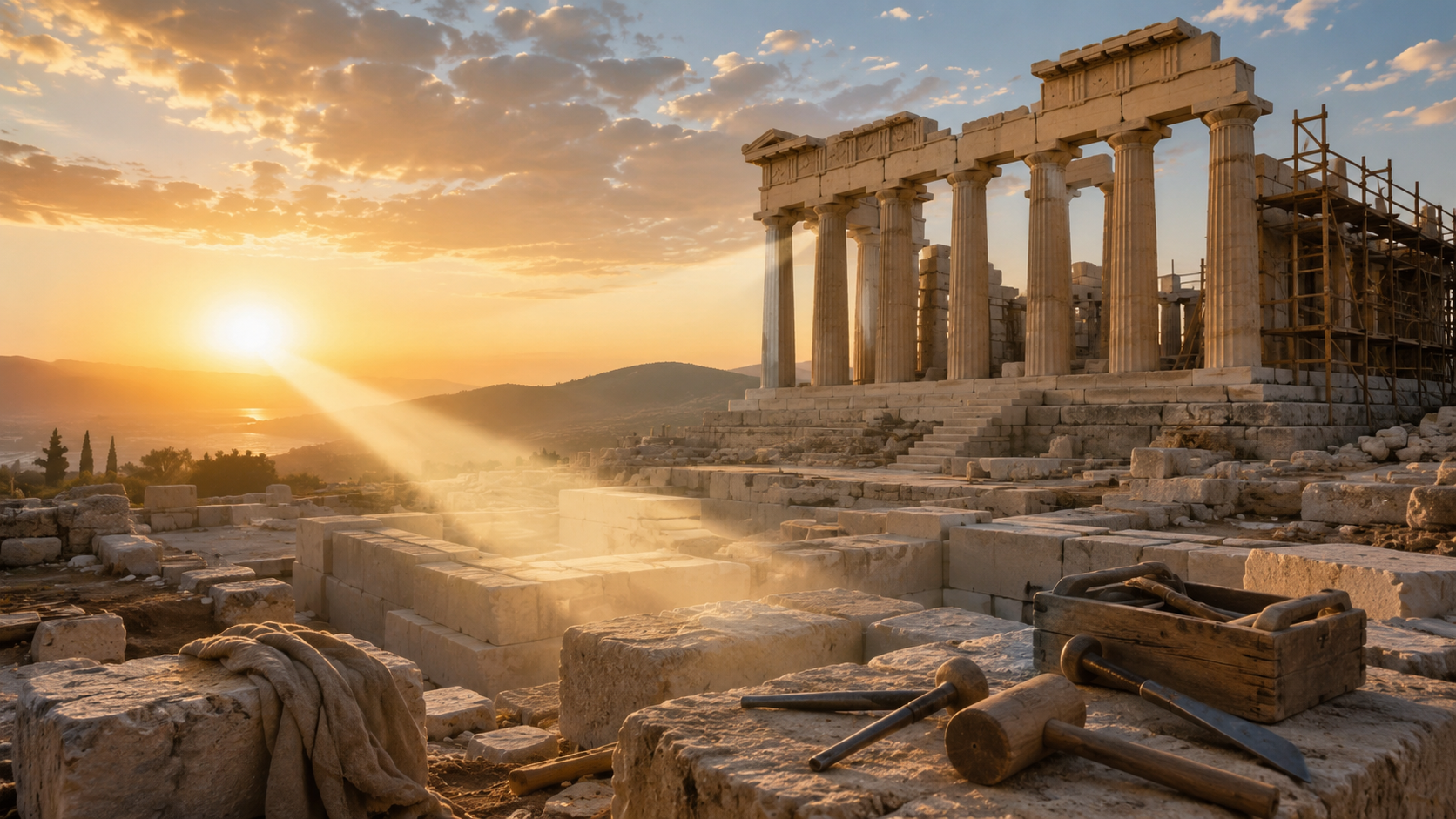
An Investigation into the Architecture of Creation, Solomon’s Temple, and the Masonic Lodge
If God Cannot Be Contained, Why Build a Temple?
“But will God indeed dwell on the earth? behold, the heaven and heaven of heavens cannot contain thee;
how much less this house that I have builded?”
– 1 Kings 8:27 (KJV)
A building is ordinarily justified by what it encloses. A house encloses domestic life; a treasury secures wealth; a court provides a chamber in which judgment may be heard; a fortress protects those within it from dangers beyond its walls. Architecture gives an activity a location, establishes a boundary around it, and supplies the material conditions under which it may continue. The biblical Temple appears at first to conform to this ordinary logic. It is called a house; it possesses courts, doors, chambers, furnishings, officers, and an inner place of exceptional restriction. Yet at the moment of its dedication, the king who built it declares that the very One for whom it has been raised cannot be enclosed by it. Solomon does not only concede that the Temple is small in comparison with heaven. He states that even “the heaven and heaven of heavens” cannot contain God, and then asks how the house he has built could possibly do so. The central prayer of the Temple therefore begins by denying the most obvious explanation for the Temple’s existence.1
This is not a minor theological qualification placed at the edge of the narrative. It is the paradox at the centre of the institution. The house is dedicated to the divine presence, yet the divine presence exceeds every house. The cloud fills the sanctuary, yet Solomon directs prayer toward heaven. The Temple bears the divine Name, yet the king refuses to identify the building with the totality of God. The architecture is treated as indispensable, but not absolute; holy, but not possessive; authorised, but incapable of confining the authority from which it derives. A careless reading dissolves the tension by choosing one side. It either imagines the Temple as a literal container of God, or reduces it to an empty symbol whose physical form is ultimately incidental. The text permits neither conclusion as it insists upon presence without imprisonment and transcendence without irrelevance.
Investigation One established that human beings build sacred spaces because attention requires orientation, memory requires embodiment, ritual requires placement, and communities require visible forms through which invisible obligations become inhabitable. The Temple now subjects that general account to a more severe test. A sacred building may help human beings perceive, remember, and approach; but why should a biblical tradition that repeatedly rejects divine containment command the construction of a sanctuary in exacting detail? What does the Temple accomplish that the universe, the covenant, the law, and prayer do not accomplish without it? The answer cannot be reached by treating the Temple merely as an archaeological object or by assuming that later Masonic familiarity has already explained it. We must allow the paradox to remain open long enough to discover what kind of institution could be necessary without being capable of containing the reality it serves.
The House God Does Not Need
The denial of divine containment is not unique to Solomon’s dedication. Isaiah places a similar question in the mouth of God: heaven is the divine throne and earth the divine footstool, so what house could human beings build as a place of rest? The speech does not end with a rejection of worship or material existence; it redirects attention toward the person who is humble, contrite, and attentive to the divine word. The Acts of the Apostles later invokes the same prophetic passage while recalling the Tabernacle and the Temple. Whatever differences of context and theology separate these texts, they converge upon a basic proposition: no structure made by human hands can establish jurisdiction over God.2 The sacred building cannot make the Infinite present by force, cannot guarantee favour by its permanence, and cannot bind judgment to the interests of its custodians.
It would nevertheless be a mistake to interpret these passages as a simple biblical hostility to architecture. The same scriptural corpus that denies containment devotes extraordinary narrative space to sanctuary construction, materials, measurements, craftsmanship, dedication, sacrifice, procession, music, and prayer. The contradiction is deliberate. The Temple is criticised whenever it pretends to become sufficient unto itself, but the act of building is not thereby dismissed. The text distinguishes between a house treated as an instrument of covenantal order and a house treated as an instrument of divine possession. The former disciplines the community; the latter attempts to discipline God.
The distinction becomes clearer when divine need is separated from human need. God does not require shelter from weather, protection from enemies, a throne from which to acquire sovereignty, or a chamber in which to become present. Israel, however, requires a centre around which covenantal life may be ordered. A people moving through history must remember what binds it, where authority lies, how approach is regulated, when common observance occurs, and what obligations accompany nearness to the Holy. The Temple answers those human requirements without implying a deficiency in God. It is not a technological solution to divine absence, but an institutional response to human dispersion.
Ancient Near Eastern temples were commonly conceived as houses of deities, and the biblical narratives of sanctuary and temple construction participate in a wider regional world of building accounts, consecration rites, divine enthronement imagery, specialist craftsmen, precious materials, and royal patronage. Yet the Israelite texts also revise and contest that world. Solomon’s prayer refuses the naïve equivalence between a divine house and divine containment; the ark holds the covenantal tablets rather than an image of the deity; and prophetic tradition repeatedly subjects the sanctuary to ethical judgment.3 The Temple is therefore intelligible only when both resemblance and resistance are preserved. It speaks the architectural language of its world while refusing to allow architecture to become ownership of the Divine.
From Sinai to a Dwelling in the Midst
Within the biblical narrative, the command to build a sanctuary does not arise in isolation. It follows liberation from Egypt, arrival at Sinai, the giving of covenantal commands, and the public acceptance of obligation. The sequence matters. A sanctuary is not introduced as a substitute for covenant but as a spatial continuation of it. “Let them make me a sanctuary; that I may dwell among them,” declares Exodus, followed immediately by the requirement that the Tabernacle and its furnishings be made according to a pattern shown to Moses.4 The institution begins not with a ruler’s desire for magnificence but with a relationship already established through deliverance, word, and consent.
The wording “among them” is more significant than a casual reading may suggest. The Tabernacle is portable. It does not initially immobilise sacred presence in a capital or make proximity dependent upon residence near a royal city. The cloud that signifies presence also governs movement: when it is taken up, the people journey; when it remains, they remain. The sanctuary stands within the ordered camp, surrounded by the tribes and guarded by differentiated responsibilities. In literary terms, the people do not merely travel toward a distant sacred centre; the centre travels with them. The result is not a deity trapped in a tent, but a community organised around a presence it can neither manufacture nor command.5
The conclusion of Exodus intensifies rather than resolves the paradox. When the work is finished, the cloud covers the Tent of Meeting and the glory of the Lord fills the Tabernacle so completely that Moses cannot enter it. The same narrative pattern later appears at the dedication of Solomon’s Temple, when the priests cannot stand to minister because the cloud fills the house.6 In both cases, the moment of divine filling suspends human control. The building has been constructed precisely as commanded; the authorised ministers are present; the furnishings occupy their appointed places; yet the institution cannot proceed as though presence were an administrative resource. The first consequence of indwelling is not mastery but interruption.
The ark at the centre of the inner sanctuary sharpens the point. Its defining content is covenantal testimony: the tablets associated with the divine command. Exodus presents the ark as the place above which God will meet Moses and communicate, while the narrative of Solomon’s dedication emphasises that the tablets placed there witness to the covenant. The material centre therefore holds neither a portrait nor a manageable body of God. It holds words of obligation.7 The sacred centre is not empty, but what it contains places the community under judgment. The institution does not merely assure the people that God is with them; it preserves the terms by which life with God is to be ordered.
The construction itself is communal without being formless. Materials are contributed, skilled artisans are named, craftsmanship is described as wisdom, and the work proceeds under a received design. Bezalel and Oholiab do not become significant by abolishing constraint; they become significant by translating command into excellent form. The people’s generosity, the craftsmen’s intelligence, Moses’ oversight, and the prescribed pattern converge.8 Sacred building is thus presented as disciplined cooperation. Authority without craft would remain abstract; craft without authority would become arbitrary; generosity without order would produce accumulation rather than sanctuary. The Tabernacle exists because relation is made architectural.
The Pattern Shown on the Mountain
The repeated command to build according to a pattern introduces a difficult question. What exactly was shown to Moses? The Hebrew term commonly translated as “pattern” can refer to a form, model, likeness, or design. Exodus does not provide a modern technical drawing, and its descriptions leave many questions that an architect attempting a literal reconstruction would need answered. The text’s precision is real, but it is not the precision of a complete set of construction documents. This has led interpreters to different conclusions: some imagine a heavenly archetype, others a visible model, others a literary means of establishing divine authorisation, and still others a textual architecture intended to form the reader’s imagination.9
The disagreement should not be concealed, because the argument of this manuscript does not require certainty where the evidence does not supply it. The essential point is narrower. The biblical builder is not presented as inventing the sanctuary from unrestricted preference. The form is received before it is executed. Hebrews later describes the earthly sanctuary as a copy and shadow of heavenly things and cites the command to make everything according to the pattern shown on the mountain. That later interpretation intensifies the idea of correspondence, but the underlying discipline is already present in Exodus: legitimate construction answers to an order prior to the builder.10
This is the first reason that the Temple cannot be understood merely as royal self-expression. Monumental architecture ordinarily magnifies the person who commissions it. Palaces, triumphal arches, tombs, and capitals can turn wealth into stone and power into landscape. Biblical sanctuary tradition places a counter-principle beside that political reality. The authorised builder must submit to a pattern he did not originate. Magnificence alone is not fidelity. A structure may be technically accomplished, visually overwhelming, and politically useful while remaining corrupt in purpose or disordered in relation to the law it claims to serve.
The concept of pattern therefore imposes a governance test upon sacred architecture. Who authorised the project? According to what prior obligation is it being built? What is the relationship between the commissioner, the craftsmen, the ministers, and the community? Can the custodians amend the meaning of the institution merely because they control its physical site? In the biblical narrative, the builder’s authority is derivative. Moses, David, Solomon, priests, and craftsmen occupy different roles, but none creates the sacred order from nothing. Their legitimacy depends upon faithful mediation.
A pattern should not, however, be confused with a fetish of exact replication. If the lesson were only that holiness inheres in copying dimensions, the transition from movable Tabernacle to permanent Temple would itself be difficult to explain, for the structures are related but not identical. The deeper continuity lies in ordered correspondence: centre and boundary, approach and restriction, covenant and presence, word and worship, service and accountability. Physical form carries these relations, but no single material configuration exhausts them. The pattern is not a magical code hidden in measurements. It is an order that measurements help to make inhabitable.
The Grammar of Approach
The Tabernacle and Temple do not present holiness as a uniform atmosphere spread evenly across an undifferentiated room. They establish zones. There is an exterior and an interior, a court and a sanctuary, a holy place and an inner sanctum; there are ordinary days and appointed times, general participation and specialised service, permitted actions and prohibited approaches. Philip Peter Jenson describes this priestly world through the concept of graded holiness, in which spatial, personal, material, ritual, and temporal distinctions form an integrated order.11 The closer one moves toward the centre, the more demanding the conditions of approach become.
Modern readers may instinctively interpret every distinction as inequality and every restriction as domination. That suspicion is sometimes justified, especially where custodians convert service into privilege. Yet it cannot be assumed that all boundaries are oppressive merely because they limit access. A boundary may express the seriousness of relation. A court, threshold, veil, period of preparation, or authorised role teaches that approach is consequential. The institution refuses the idea that nearness to the Holy is casual, self-certified, or indistinguishable from ordinary movement.
The graded order also protects the community from the presumption that desire alone establishes competence. Not every person performs every function, not every moment permits every action, and not every space is entered on identical terms. In a healthy institution, such differentiation is accompanied by a clear account of purpose, responsibility, and accountability. The priest is not holier in the sense of possessing a superior human essence; he bears a more restricted duty within the ritual order. The centre is not valuable because it humiliates the perimeter; the perimeter is ordered so that the centre can remain meaningful.
Architecture makes this grammar bodily. Walls, curtains, doors, elevations, narrowing passages, furnishings, materials, light, silence, scent, and movement do not merely illustrate a doctrine already complete in words. They train the participant to experience relation through sequence. Jenson’s analysis of material and sensory gradation, and broader scholarship on the Temple’s progression through increasingly restricted spaces, show that holiness is made perceptible through differences that can be seen, crossed, heard, and felt.12 The body learns that approach has order before the intellect can fully explain why.
This architecture nevertheless contains a permanent institutional danger. Those entrusted with a threshold can begin to imagine that they own what lies beyond it. The authorised interpreter can turn mediation into monopoly; the servant of the centre can confuse proximity with possession; the guardian of procedure can use sanctity to shield arbitrary power. The biblical Temple is not naïve about this possibility. Its spatial hierarchy is accompanied by prophetic criticism so severe that the custodians’ control of the site becomes evidence against them rather than proof of legitimacy. The grammar of approach must therefore be read together with the grammar of accountability.
A House for the Name
The language of the divine Name supplies the most important textual bridge between presence and transcendence. In the narrative of David’s proposed building project, the promised successor will build a house for God’s Name. Solomon repeats that formulation when explaining the purpose of his work. At the dedication he asks that God’s eyes be open toward the house of which God has said, “My name shall be there,” while asking God to hear prayer in heaven.13 The Temple is therefore simultaneously local and beyond locality: the Name is associated with the house, but hearing belongs to heaven.
Biblical scholarship has long debated how this language should be understood. A major line of interpretation treated “Name theology” as a development that relocated God from the Temple to heaven, leaving the Name as a more abstract or hypostatised form of presence within the sanctuary. Sandra Richter’s comparative study challenged parts of that consensus, arguing that the relevant idioms need not imply a detachable divine personality residing in the building and may communicate ownership, reputation, memorial, or authorised association.14 The debate is technical, but its existence is instructive. The text cannot be responsibly reduced either to crude localisation or to effortless abstraction.
For the purpose of this investigation, we need not resolve every philological dispute. Solomon’s prayer itself performs the necessary work. The house is a recognised address of covenantal attention; the Name, the ark, the altar, and the history of divine promise gather there. Yet prayer does not terminate in the masonry. It passes through the orientation supplied by the Temple toward the God who hears from heaven. The building gives direction without imposing limits. It establishes a point of reference without converting reference into confinement.
This is why the Temple may be understood as an address rather than a prison. An address does not contain the person to whom correspondence is sent in every dimension of existence; it establishes an authorised point of relation. The Temple tells Israel where communal memory, sacrifice, prayer, covenantal testimony, and appointed service converge. Its location permits common orientation. Its procedures make approach public rather than privately improvised. Its continuity enables generations to direct themselves toward the same remembered promises. Yet the addressee exceeds the address.
The structure of Solomon’s prayer confirms this function. It considers disputes requiring oath and judgment, defeat by enemies, drought, famine, plague, individual affliction, the prayer of the foreigner, battle, sin, and exile. These are not interior decorating themes; they are conditions of communal existence. Each petition turns toward the Temple while asking the God of heaven to hear and act. Scholars have accordingly analysed the prayer not only as liturgy but also as a programmatic statement about the Temple’s place within the Deuteronomistic history and the royal order.15 The house becomes the focal institution through which the full instability of national life is placed under divine judgment.
Two petitions are especially important. The foreigner who comes from a distant land because of the divine Name is to be heard, so that the peoples of the earth may know that Name. The exiled Israelite, physically removed from the land and the building, may pray toward the land, the city, and the house, and still ask to be heard in heaven.16 These cases prevent the Temple from collapsing into a tribal possession or a local mechanism. Its orientation extends beyond those who stand inside it. The institution is most itself when it directs attention beyond itself.
Covenant Made Public
The Temple’s centre contains another restraint upon institutional self-glorification: the covenantal tablets. At the dedication, the narrative emphasises that the ark contains the two tables placed there by Moses, associated with the covenant made after the exodus. Solomon then declares that he has provided a place for the ark in which that covenant is preserved.17 The central object of national sacred architecture therefore bears a memory of liberation and obligation. Royal achievement surrounds a testimony that precedes the king.
In modern analytical language, the Temple may be described as a form of covenantal infrastructure. The phrase is interpretive, not biblical, but it clarifies the institutional function. Infrastructure does not merely display values; it enables repeated coordination around them. The Temple gathers law, calendar, sacrifice, priestly service, music, pilgrimage, royal patronage, public memory, and communal prayer into a durable centre. It makes the covenant visible in time and space. It also creates roles, archives, revenues, routines, and lines of authority by which the institution can endure beyond a single generation.18
This durability is one reason sacred architecture matters. A spoken commitment can be forgotten, a private conviction can weaken, and a charismatic founder can die. An institution gives memory successors. The Temple outlives the builders who laid its stones and the worshippers who first entered its courts. It allows children to inhabit a structure received from ancestors, to encounter obligations they did not invent, and to discover that communal life began before their own arrival. Continuity becomes spatial.
Yet infrastructure is never neutral. The same centre that coordinates can centralise; the same institution that preserves can select; the same architecture that embodies unity can magnify the authority of those nearest to it. The Temple stood in relation to the monarchy, and the narrative of its construction is inseparable from royal labour, wealth, diplomacy, taxation, and legitimacy. Scholars have therefore read Solomon’s dedication not only as theology but as political rhetoric that links the Davidic house, the chosen city, and the chosen sanctuary.19 The Temple may unite the people, but it also helps define who speaks for the people.
This concentration of authority creates the decisive governance question: who controls the centre, and by what standard is that control judged? A sacred institution can claim to mediate covenant while gradually subordinating covenant to institutional survival. It can preserve the law physically while violating it administratively. It can use inherited symbols to authenticate decisions that the underlying tradition would condemn. The Temple’s greatness therefore does not remove the need for accountability; it intensifies it. The more an institution concentrates memory, authority, and identity, the more dangerous its capture becomes.
The Prophetic Stress Test
Jeremiah’s Temple sermon is the most uncompromising stress test of sacred institutional legitimacy in the Hebrew Bible. The prophet is commanded to stand at the gate of the Lord’s house, precisely where worshippers enter, and confront those who trust in the repeated slogan, “The temple of the LORD.” Their confidence is not presented as atheism. They believe in the Temple’s significance; they continue to worship; they appeal to inherited sanctity. Their error lies in treating the building as a guarantee that can survive the collapse of justice.20
The indictment is concrete. The people are commanded to amend their ways, execute judgment, cease oppressing the stranger, the fatherless, and the widow, stop shedding innocent blood, and abandon other forms of covenantal betrayal. Only then can the claim to dwell in the land retain meaning. The sermon thus refuses to separate sacred architecture from social order. A house bearing the divine Name cannot legitimate a community that systematically violates the obligations associated with that Name.
Jeremiah then invokes Shiloh, an earlier sanctuary associated with divine presence, as evidence that sacred history does not confer immunity. The people are told to examine what happened there because of wickedness. The Temple in Jerusalem may likewise be judged. The argument is devastating because it uses institutional memory against institutional arrogance. Precedent does not prove invulnerability; precedent proves that a sanctuary can lose its standing when its custodians convert election into exemption.21
Other prophetic texts press the same principle. Micah condemns rulers who judge for reward, priests who teach for hire, and prophets who divine for money while still claiming that the Lord is among them and that disaster cannot come. Isaiah joins critique of worship to a demand for justice, and later places divine regard upon the humble and contrite rather than upon the presumed adequacy of a house.22 These are not attacks upon order, ritual, or sacred memory as such. They are attacks upon procedure detached from truth.
The institutional lesson is precise. A sacred centre must be tested by the conduct it authorises, rewards, excuses, and produces. Perfect ceremony cannot cure corrupt judgment. Custody of venerable symbols cannot substitute for fidelity to their moral demand. Architectural continuity cannot legitimise the exploitation of the vulnerable. When procedure becomes theatre, sanctity becomes a shield behind which power hides. The prophetic office breaks that shield by returning the institution to its originating obligations.
This is why the Temple’s vulnerability to destruction is not a contradiction of its sacred significance. The possibility of judgment is part of that significance. An institution genuinely subordinate to transcendent authority cannot declare itself beyond correction. If its continued existence becomes the highest good, it has already displaced the reality it was established to serve. The Temple is not legitimate because it stands; it stands legitimately only while its life remains answerable to covenant.
Presence in Absence
Solomon’s prayer anticipates the possibility that the people will be defeated, carried into captivity, and removed from the physical Temple. The imagined exile is not treated as a condition in which relation becomes impossible. The displaced community may turn in thought and prayer toward the land, the city, and the house; God may hear in heaven and maintain their cause.23 The Temple therefore establishes an orientation capable of surviving distance. Its function can persist when bodily access is denied.
This feature becomes historically decisive. The First Temple was destroyed by the Babylonian forces in the early sixth century BCE, conventionally dated to 586 or 587 BCE, and the later Temple was destroyed by Rome in 70 CE.24 The destruction of a sacred building is a political, social, theological, and psychological catastrophe; it should not be romanticised as though loss were insignificant. Yet the traditions formed around the Temple did not conclude that God had ceased to exist because the sanctuary had fallen. The very theology that denied containment made it possible to interpret destruction as judgment, exile, rupture, and transformation without equating the ruin of architecture with the annihilation of the Divine.
Absence reveals what a building had been doing. When the Temple is present, stone, priesthood, festival, sacrifice, and public memory are experienced together. When it is absent, those functions separate and become visible: prayer can continue; text can preserve memory; orientation can remain; obligation can be renewed; community can assemble in other forms; hope can be projected toward restoration. The building was never irrelevant, but neither was it the totality of the relationship.
The paradox has now become clearer. The Temple is built because human beings require a durable centre from which covenant can be remembered, approach ordered, common time established, prayer oriented, and authority judged. It cannot contain God because the reality it serves is the source of its authority and therefore exceeds it. The Temple is strongest when it acknowledges this asymmetry. Its walls organise human movement; they do not establish divine limits. Its centre gathers attention; it does not become the centre of God’s being. Its destruction can devastate a people; it cannot destroy the order to which the institution was answerable.
This also explains why restoration cannot be merely architectural. Rebuilding walls without restoring justice reproduces the shell while abandoning the covenant. Recovering ritual without recovering humility mistakes performance for presence. The prophetic tradition insists that the Temple’s true reconstruction begins wherever the relationship between form and obligation is repaired. Sacred architecture endures only when architecture remains transparent to the reality beyond it.
The Masonic Threshold
Only at this stage should the Masonic Lodge enter the investigation. To introduce it earlier would invite inherited explanations to predetermine the conclusion. English Craft Freemasonry draws extensively upon the building of King Solomon’s Temple as an allegorical and ceremonial setting, but it does not claim to recreate the theology, priesthood, sacrifices, or divine indwelling of the biblical sanctuary. The United Grand Lodge of England is explicit that Freemasonry is not a religion, has no religious affiliation, and must not blur the boundary between Masonic practice and religion.25 That distinction is not an obstacle to serious reflection; it is the discipline that keeps reflection honest.
UGLE publicly describes the Lodge room as thoughtfully arranged, with designated places for officers and ceremonies through which members reflect upon conduct and responsibility. Its educational resources likewise present Freemasonry as a journey through history, tradition, symbolism, and moral lessons.26 The Lodge is therefore an ordered symbolic environment, but it is not a Temple in the theological sense examined above. No arrangement of furniture, no correctness of ceremonial form, and no invocation of Solomon can convert a Masonic meeting place into a divine dwelling.
The distinction makes the Temple allegory more demanding rather than less. If Solomon’s Temple did not contain God, then the Lodge cannot be treated as a mechanism that automatically produces light, virtue, harmony, or wisdom. It can orient attention, embody relationships, preserve memory, regulate progression, and offer symbols through which the Mason examines himself. But the reality must be enacted beyond the architecture. A perfectly furnished Lodge can still fail morally; flawless ritual can coexist with injustice; seniority can be confused with wisdom; custody of tradition can become a claim of immunity from criticism.
English Masonic history shows that Temple language and building allegory became central elements through which speculative Masonry organised moral instruction.27 The significance of that inheritance lies not in pretending that eighteenth-century Freemasons possessed a secret architectural science unavailable to historians. It lies in the recognition that building supplies a disciplined vocabulary for character: foundations, proportion, labour, testing, alignment, superstructure, completion, and accountability to a plan. The biblical Temple deepens that vocabulary by adding a warning. The builder is never the owner of the order he serves.
The Masonic Lodge may therefore be understood as an architecture of moral orientation. Its legitimacy does not arise solely from regular form, inherited warrant, or accurate performance, indispensable though these may be to institutional continuity. It must also be tested by what its order produces in the lives and relations of its members. Does its hierarchy cultivate service or entitlement? Do its obligations generate fidelity or become ceremonial speech? Does its harmony rest upon justice or upon the silencing of necessary truth? The prophetic stress test of the Temple follows the Mason into the Lodge.
Resolution: Why Build?
If God cannot be contained, the Temple is not built to solve a divine problem. It is built to discipline a human relationship. It gives covenant a public centre, memory a durable body, prayer a common orientation, approach a grammar, service an order, time a rhythm, craftsmanship a purpose, and authority a visible place at which it can be judged. It gathers a dispersed people without claiming that the One who gathers them is confined to the gathering place. It makes the invisible obligations of covenant inhabitable while preserving the decisive inequality between the institution and the reality from which the institution derives its meaning.
The Temple’s necessity is therefore conditional and relational. It is necessary because human beings forget, disperse, improvise, compete for authority, and require structures capable of carrying memory across generations. It is conditional because no structure can replace fidelity. The house may bear the Name and still be condemned; the authorised officers may occupy their places and still corrupt their offices; the ritual may continue while justice disappears. Sacred architecture is not self-authenticating. Its legitimacy is continuously tested by correspondence between the order it displays and the conduct it produces.
We can now answer Solomon’s paradox without dissolving it. God cannot be contained, and that is precisely why the Temple must never become an idol of institutional self-sufficiency. The building exists to direct the community beyond the building, the Name beyond possession, the law beyond ceremony, and presence beyond control. It is a centre whose truth depends upon its refusal to become the whole.
One question remains. If the Tabernacle was made according to a pattern shown on the mountain, if Solomon inherited rather than invented the language of sanctuary, and if the Temple’s order was understood to correspond to a reality beyond itself, where did that pattern originate? Was Solomon’s Temple an unprecedented human design, or an earthly articulation of an architecture already disclosed in creation, covenant, and the wider world of sacred building? The next investigation begins there: Did Solomon invent sacred architecture?
Notes and References
1. The Holy Bible, Authorized King James Version, 1 Kings 8:12-30; see also 2 Chronicles 6:1-21. Solomon’s dedication holds together the cloud-filled house, the divine Name, prayer directed toward the Temple, and the declaration that even heaven cannot contain God.
2. The Holy Bible, KJV, Isaiah 66:1-2 and Acts 7:44-50. See R. E. Clements, God and Temple: The Idea of the Divine Presence in Ancient Israel (Oxford: Basil Blackwell; Philadelphia: Fortress Press, 1965), for a historical-theological study of divine presence and sanctuary traditions.
3. Stephen L. Cook, “The Temple in the Christian Bible,” St Andrews Encyclopaedia of Theology, 10 August 2023; Victor Avigdor Hurowitz, I Have Built You an Exalted House: Temple Building in the Bible in Light of Mesopotamian and Northwest Semitic Writings, JSOT Supplement Series 115 (Sheffield: JSOT Press, 1992). Hurowitz compares the biblical building accounts with Mesopotamian and Northwest Semitic traditions; Cook surveys the Temple as an intersection of terrestrial and transcendent spheres.
4. The Holy Bible, KJV, Exodus 19-25, especially 24:3-8 and 25:8-9; Exodus 29:43-46. The narrative sequence places sanctuary construction after liberation, covenantal speech, and public commitment.
5. The Holy Bible, KJV, Exodus 40:34-38; Numbers 2-3. Naomi Koltun-Fromm, “Giving Readers Access to the Divine: Temple Versus Tabernacle,” TheTorah.com, 19 March 2017, discusses the literary placement of the Tabernacle in the midst of Israel and its role as the centre of the camp.
6. The Holy Bible, KJV, Exodus 40:34-35 and 1 Kings 8:10-11. The parallel cloud-filling scenes emphasise presence while temporarily preventing authorised entry or ministry.
7. The Holy Bible, KJV, Exodus 25:10-22; 31:18; Deuteronomy 10:1-5; 1 Kings 8:9, 21. The ark is associated with the covenantal tablets and with the place of divine communication.
8. The Holy Bible, KJV, Exodus 31:1-11 and 35:20-36:7. The sanctuary is constructed through prescribed authority, communal contributions, specialised skill, and named craftsmanship. See also Hurowitz, I Have Built You an Exalted House.
9. The Holy Bible, KJV, Exodus 25:9, 40; 26:30. On the interpretive problem presented by the textual description, see Amy Cooper Robertson, “Building the Tabernacle in Your Mind,” TheTorah.com, 12 March 2024.
10. The Holy Bible, KJV, Hebrews 8:1-5, which interprets the earthly sanctuary as a copy and shadow and cites Exodus 25:40. This manuscript treats that as a later canonical interpretation while distinguishing it from claims about recoverable technical blueprints.
11. Philip Peter Jenson, Graded Holiness: A Key to the Priestly Conception of the World, JSOT Supplement Series 106 (Sheffield: JSOT Press, 1992), especially chaps. 3-6. Jenson analyses holiness as an ordered spectrum expressed spatially, personally, materially, ritually, and temporally.
12. The Holy Bible, KJV, Exodus 26-30; Leviticus 16. See Jenson, Graded Holiness, 89-180; Cook, “The Temple in the Christian Bible,” on the sequence of increasingly restricted spaces in the Tabernacle and Temple traditions.
13. The Holy Bible, KJV, 2 Samuel 7:1-17; 1 Kings 5:3-5; 8:15-21, 27-30. The building is repeatedly described as a house for the divine Name, while God is asked to hear in heaven.
14. Sandra L. Richter, The Deuteronomistic History and the Name Theology: lešakkēn šĕmô šām in the Bible and the Ancient Near East, Beihefte zur Zeitschrift für die alttestamentliche Wissenschaft 318 (Berlin: Walter de Gruyter, 2002), especially the introduction and her reassessment of the standard ‘Name theology’ paradigm.
15. G. N. Knoppers, “Prayer and Propaganda: Solomon’s Dedication of the Temple and the Deuteronomist’s Program,” Catholic Biblical Quarterly 57, no. 2 (1995): 229-254. See also Jon D. Levenson, Sinai and Zion: An Entry into the Jewish Bible (San Francisco: Harper & Row, 1985), for covenantal and Zion traditions.
16. The Holy Bible, KJV, 1 Kings 8:31-53, especially vv. 41-43 concerning the foreigner and vv. 46-50 concerning exile and prayer directed toward the land, city, and house.
17. The Holy Bible, KJV, 1 Kings 8:9, 21; Deuteronomy 10:1-5. The ark’s covenantal content places the king’s building achievement under a prior history and obligation.
18. Jon D. Levenson, Sinai and Zion; Clements, God and Temple; Cook, “The Temple in the Christian Bible.” The phrase ‘covenantal infrastructure’ is the present manuscript’s institutional interpretation, not a direct biblical term.
19. Knoppers, “Prayer and Propaganda”; Koltun-Fromm, “Giving Readers Access to the Divine,” especially her analysis of the Jerusalem shrine’s relationship to the Davidic covenant and royal centralisation. Cook also notes the Temple complex’s proximity to royal structures and its broader civic functions.
20. The Holy Bible, KJV, Jeremiah 7:1-15 and 26:1-19. Jeremiah’s sermon is delivered at the Temple gate and opposes reliance upon the sanctuary as immunity from judgment.
21. The Holy Bible, KJV, Jeremiah 7:12-14. Shiloh functions as an institutional precedent demonstrating that a place associated with the divine Name may nevertheless be judged.
22. The Holy Bible, KJV, Micah 3:9-12; Isaiah 1:10-17; 66:1-2; see also Amos 5:21-24. These texts link acceptable worship to justice and reject confidence based solely upon cultic performance or institutional proximity.
23. The Holy Bible, KJV, 1 Kings 8:46-50. Solomon’s prayer anticipates captivity and preserves an orientation toward land, city, and Temple while asking God to hear in heaven.
24. The Holy Bible, KJV, 2 Kings 25:8-10. Cook, “The Temple in the Christian Bible,” surveys the Temple’s phases of construction, destruction, rebuilding, and final destruction in 70 CE. Dates for the First Temple’s destruction are commonly given as 586 or 587 BCE depending upon chronological reconstruction.
25. United Grand Lodge of England, Information for the Guidance of Members of the Craft (London: UGLE, 2024), which warns against practices that blur the clear distinction between Freemasonry and religion; UGLE, “Freemasonry FAQs,” and “What Is Freemasonry?” Both official public explanations describe Freemasonry as having no religious affiliation.
26. United Grand Lodge of England, “Exploring Freemasonry: What Is a Lodge and Its Officers?” 12 February 2025; UGLE, “Onboarding with Solomon,” 6 December 2021. These official materials describe the ordered Lodge room, designated officers, ceremonial traditions, and structured learning about history and symbolism.
27. Douglas Knoop, G. P. Jones, and Douglas Hamer, The Early Masonic Catechisms, 2nd ed. (Manchester: Manchester University Press, 1963); John Hamill, The Craft: A History of English Freemasonry (Wellingborough: Crucible, 1986); David Stevenson, The Origins of Freemasonry: Scotland’s Century, 1590-1710 (Cambridge: Cambridge University Press, 1988). These works document the historical emergence of speculative Masonic language, catechisms, building allegory, and Temple-related traditions without requiring occult or pseudo-historical claims.
Selected Bibliography
The Holy Bible. Authorized King James Version.
Clements, R. E. God and Temple: The Idea of the Divine Presence in Ancient Israel. Oxford: Basil Blackwell; Philadelphia: Fortress Press, 1965.
Cook, Stephen L. “The Temple in the Christian Bible.” St Andrews Encyclopaedia of Theology. 10 August 2023.
Hamill, John. The Craft: A History of English Freemasonry. Wellingborough: Crucible, 1986.
Hurowitz, Victor Avigdor. I Have Built You an Exalted House: Temple Building in the Bible in Light of Mesopotamian and Northwest Semitic Writings. JSOT Supplement Series 115. Sheffield: JSOT Press, 1992.
Jenson, Philip Peter. Graded Holiness: A Key to the Priestly Conception of the World. JSOT Supplement Series 106. Sheffield: JSOT Press, 1992.
Knoppers, G. N. “Prayer and Propaganda: Solomon’s Dedication of the Temple and the Deuteronomist’s Program.” Catholic Biblical Quarterly 57, no. 2 (1995): 229-254.
Knoop, Douglas, G. P. Jones, and Douglas Hamer. The Early Masonic Catechisms. 2nd ed. Manchester: Manchester University Press, 1963.
Koltun-Fromm, Naomi. “Giving Readers Access to the Divine: Temple Versus Tabernacle.” TheTorah.com. 19 March 2017.
Levenson, Jon D. Sinai and Zion: An Entry into the Jewish Bible. San Francisco: Harper & Row, 1985.
Richter, Sandra L. The Deuteronomistic History and the Name Theology: lešakkēn šĕmô šām in the Bible and the Ancient Near East. BZAW 318. Berlin: Walter de Gruyter, 2002.
Robertson, Amy Cooper. “Building the Tabernacle in Your Mind.” TheTorah.com. 12 March 2024.
Stevenson, David. The Origins of Freemasonry: Scotland’s Century, 1590-1710. Cambridge: Cambridge University Press, 1988.
United Grand Lodge of England. Book of Constitutions. Craft Rules, February 2026 edition.
United Grand Lodge of England. Information for the Guidance of Members of the Craft. London: UGLE, 2024.
United Grand Lodge of England. “Exploring Freemasonry: What Is a Lodge and Its Officers?” 12 February 2025.
United Grand Lodge of England. “Freemasonry FAQs.”
United Grand Lodge of England. “Onboarding with Solomon.” 6 December 2021.
Leave a Reply