



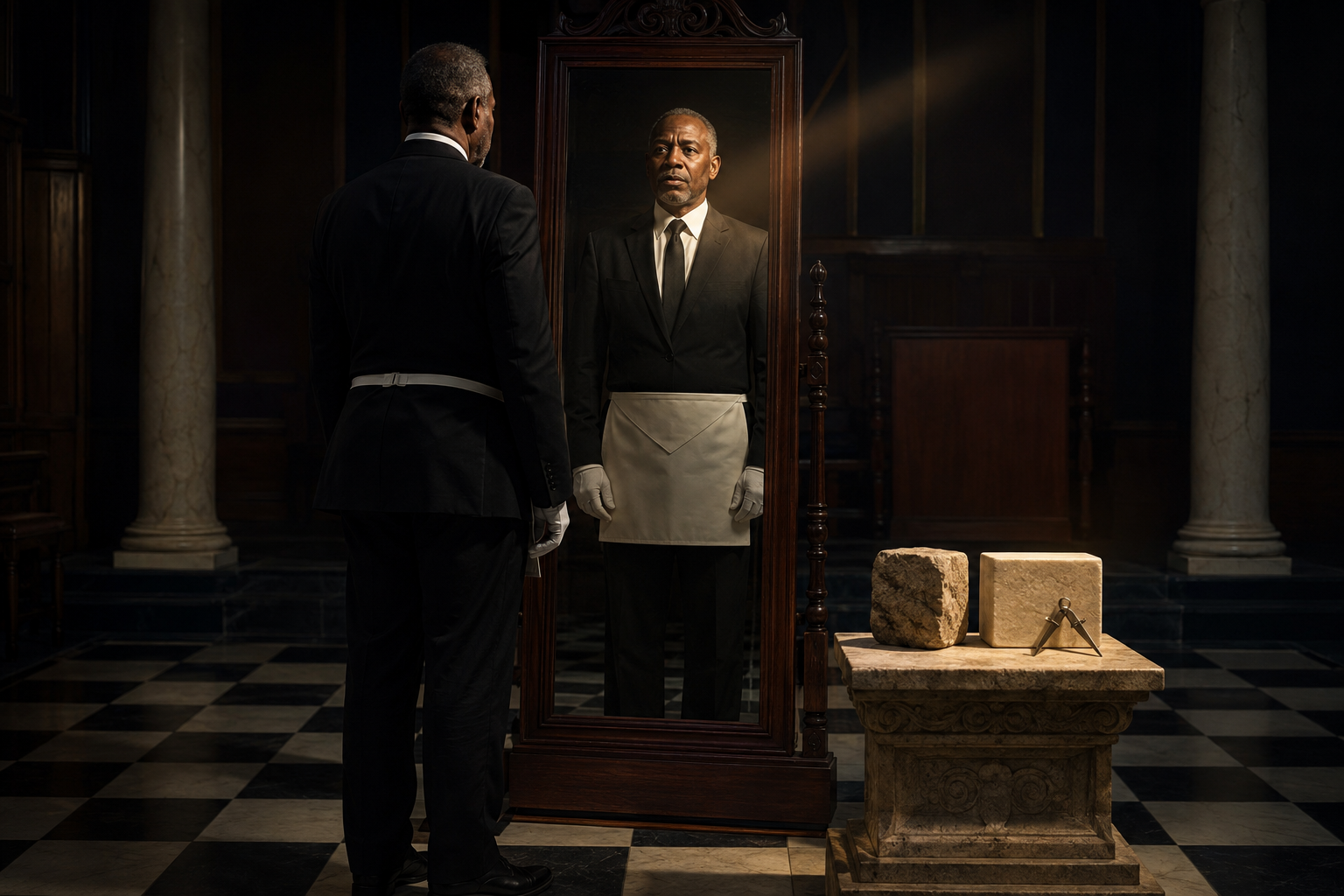
Ritual Proficiency and the Discipline of Moral Progress
Before a candidate may be Passed, he must demonstrate proficiency in the First Degree. The ritual tests what he has retained. The deeper examination begins when truth tests whether knowledge governs conduct, especially when ego has something to lose.
In Emulation workings, proficiency has a precise ceremonial meaning. Before a candidate can be Passed, the Worshipful Master declares that it is (first requisite that he give proofs of proficiency in the former) degree. The prescribed questions test whether the Entered Apprentice has retained and can reproduce the essential instruction already communicated.
Proficiency is, therefore, an adequate and practised command of the former Degree. It denotes readiness: the foundation has been laid well enough for further labour to rest upon it. The Junior Deacon may prompt where necessary, which shows that the test is not a competition in flawless theatrical memory; its object is intelligent retention, and not verbal display.
The requirement exists because advancement is not intended to arise from the passage of time alone. Each Degree rests upon the one before it. If satisfactory proof is not given, the Passing should not proceed: the candidate remains an Entered Apprentice until further instruction and practice enable him to satisfy the requirement. This is not considered as a rejection of the man; it is a protection of both the learner and the lesson. To advance him while the foundation remains insecure would convert progress into ceremony without preparation. The pause says, with dignity, that he is still being formed and that the Craft owes him teaching, rather than the appearance of attainment.
History gives this threshold an added weight. Before the modern three-Degree structure became settled, early Craft practice was generally organised in two Degrees: the Entered Apprentice and a second grade described as Master Mason or Fellow Craft. At the formation of the Grand Lodge in London in 1717, surviving English evidence points to those two stages. The third Degree did not appear everywhere on one appointed day. Its emergence was gradual: an Irish manuscript of 1711 lists distinct secrets for Entered Apprentice, Fellow Craft and Master without proving three separate ceremonies; London records from 1725 remain open to interpretation; clear Scottish lodge minutes appear in 1726; and separate fees for entering, passing and raising are recorded by 1728. Samuel Prichard’s 1730 Masonry Dissected then described a recognisable three-Degree system in print.
The precise Lewis questions should not be projected unchanged into that earlier period; ritual form and wording developed over time. The historical point is different and more important. In the earlier two-stage system, the Fellow Craft or master-mason grade was the culminating grade, not the intermediate station it later became. Passing could therefore signify admission to the highest stage then practised. Against that background, proof of proficiency is no minor rehearsal before the serious work begins. It is the guarded threshold of further Masonic identity. In the present working, the candidate crosses it by recalling that “Freemasonry is a system of morality”, that its grand principles are “Brotherly Love, Relief and Truth”, and that its fit members must be “just, upright and free men of sound judgment and strict morals”. These are preliminary qualifications for progress, not decorative sentences surrounding it.
A necessary distinction now appears. Ceremonial proficiency proves that a candidate knows the required answers; it cannot, by itself, prove that he has embodied them.
The Regular initiation establishes proper entrance, and a successful examination establishes readiness for the next stage, but neither gives a permanent certificate of character. A Brother may remember every answer while his conduct departs from the morality whose language he has mastered. The words can remain polished after the principles they express have been neglected. The distance between knowing and becoming is where ego quietly enters the work.
Ego, in this context, is not only boastfulness or an appetite for applause. It is the mind’s attachment to a preferred picture of itself: I am honourable; I am experienced; I am loyal; I am the sort of man who could not have acted unjustly. That self-picture is useful until evidence threatens it. At that time, ego may defend the image instead of correcting the conduct. The inward question changes from “Is this true?” to “What will it cost me if this is admitted?” Once that exchange takes place, intelligence can become counsel for the defence. We rationalise, minimise, remember selectively, question the motive of the messenger, or postpone a decision until the fact has lost its force. Ego does not always deny truth; sometimes it exhausts truth through delay.
Ego is most dangerous when it wears an apron of virtue. Office can become a shield; seniority, a substitute for innocence; harmony, a demand that the injured be silent. Past service may create moral credit in the imagination: because I have given much, I should not now be questioned; because he is useful, this fault should be overlooked; because our reputation is good, the fact must be less grave than it appears. This is moral licensing, the use of yesterday’s good as permission for today’s evasion. It is especially persuasive in a fraternity because loyalty is genuinely valuable. Yet loyalty ceases to be a virtue when it asks conscience to falsify the account.
Truth has little moral significance when it costs nothing. Its real test begins when speaking may disturb a relationship, threaten preferment, expose an error, embarrass an officer, or oblige an institution to correct itself. Cheap truth receives applause because it demands no sacrifice. Expensive truth, on the contrary, reveals character because it places conscience in conflict with comfort. Moral decline rarely begins with a declaration that morality no longer matters. It begins in smaller permissions: a softened fact, a strategic silence, an exception for a friend, a rule applied downward but not upward. Repeated often enough, the exception becomes the culture, and the culture teaches the “good men” how not to see.
The purpose of saying this is not to furnish a lantern with which to search for faults in other Brethren. That would give ego another costume. The useful question is inward: Where do I demand evidence before believing a criticism of myself, yet accept suspicion readily when it concerns another? Which fact have I called untimely because timely truth would cost me? When did I confuse being respected with being right, or peace with the absence of challenge?
The rough ashlar is not corrected by polishing its reflection; awakening begins when a man can observe his own defence without instantly obeying it. Between the wound to pride and the next response lies a small space in which character can choose.
The ritual provides discipline for that choice. A Mason identifies himself, in part, through “a willingness at all times to undergo an examination when properly called on.” The words “at all times” deny moral immunity. Rank, seniority, friendship, popularity and past service cannot place a Brother permanently beyond scrutiny. Yet “properly” is equally important. Examination must not become punishment, or accusation without evidence. It must proceed through competent authority, fair procedure and an honest consideration of facts. Proper process creates the conditions in which truth can correct without humiliating and accountability can operate without persecution.
Ego often confuses “I was wrong” with “I am worthless.” If those statements are fused, admission feels like self-destruction, so denial appears to be survival. The Craft offers a stronger identity. A man’s action may be judged without declaring the man incapable of repair. He can separate dignity from infallibility, accept the fact, make restitution where needed, and return to labour wiser than before. A man is not diminished by discovering that he was wrong; he is diminished when ego requires him to remain wrong. Correction is not defeat. It is the next Degree of moral life.
Brotherly Love, Relief and Truth should therefore be understood as one method of moral restoration. Brotherly Love makes truth speakable without cruelty. Truth prevents love from becoming concealment. Relief helps the Brother bear the cost of repair and recover the path of upright conduct. Love without Truth becomes favouritism; Relief without accountability becomes protection from consequence; Truth without Love can become punishment disguised as principle. Their union does not ask us to choose between the person and the standard. It asks us to honour the person by refusing to abandon the standard that can restore him.
The description “just, upright and free men” is likewise a continuing obligation, not a certificate completed on the night of passing. To be just is to apply principle when the result is unwelcome, to be upright is to remain internally aligned when pressure invites compromise, and to be free is to resist captivity to fear, faction, ambition, resentment and the demands of ego. Sound judgment distinguishes evidence from suspicion and constitutional authority from personal influence. Strict morals reach beyond avoiding public scandal; they require fidelity in the private moment when concealment would be easier.
This has institutional consequences. A Lodge cannot establish moral seriousness solely through exact ceremony or regular administration. Procedure without truth can become choreography; truth without procedure can become persecution. A healthy Lodge can face unwelcome facts, determine them through proper authority, protect all parties from prejudice, correct error without degradation, and distinguish genuine peace from silence produced by fear or influence. Its leaders do not prove strength by resisting examination; they prove it by making fair examination safe. Institutions reveal their character when principle restrains the preferences of those who hold authority.
The proficiency before Passing is thus both a gate and a mirror. The candidate who cannot yet give the answers remains an Entered Apprentice until he is ready. The Brother who can recite them but refuses their claim has a different lesson to repeat. No formal ceremony demotes him, yet conscience returns him to the place where the knowledge must become a character.
Fellow Craft once marked the summit of the two-Degree Craft; today it stands on the way to further light. In either setting, real advancement is not movement through titles while the inner man stays still. It is the capacity to receive truth, survive the correction of ego, repair what has been harmed and proceed with cleaner hands. Memory proves that the lesson was retained. Conduct proves that it was understood. Character is revealed when Truth presents its invoice and we decide, awake and free, that it must still be paid.
References: Lewis Masonic, Emulation Ritual, Second Degree, Questions Before Passing, pp. 112-114; Harry Carr, “Six Hundred Years of Craft Ritual,” Ars Quatuor Coronatorum 81 (1968); Samuel Prichard, Masonry Dissected (1730). The historical transition is stated cautiously because it was gradual and the surviving evidence is incomplete.
Leave a Reply