


An Investigation into the Architecture of Creation, Solomon’s Temple, and the Masonic Lodge
Why Do Human Beings Build Sacred Spaces?
“Surely the LORD is in this place; and I knew it not.”
– Genesis 28:16 (KJV)
Take a piece of ordinary ground. Nothing in its soil announces that speech must be lowered there, that shoes must be removed, that weapons must be left outside, that one person may advance while another must wait, or that a boundary invisible to the eye nevertheless carries an obligation. The ground may have the same chemical composition as the land around it. The air above it may be no different. Yet, once a community names it, remembers an encounter upon it, buries its dead within it, erects a boundary around it, or repeatedly assembles there under an acknowledged rule, human conduct changes, the people approach differently. They cross with greater care: they will accept restraints they would resist elsewhere. They speak, stand, sit, move, and remember according to an order that the place now appears to demand.
This transformation is one of the most persistent facts of human civilisation, but it is also one of the least adequately examined. Human beings do not merely occupy space; they distinguish it. They make homes and graves, courts and shrines, memorials and sanctuaries. They assign some places to trade, others to judgment, others to mourning, others to initiation, and others to worship. A field can become a battlefield, a room can become a courtroom, a stone can become a memorial, and a building can become a temple. The material substance may remain largely unchanged, yet the moral and psychological relation between the human being and the place is altered.
The question, therefore, is not simply why people construct religious buildings. That formulation assumes too much and asks too little. The prior question is why human beings refuse to experience all space as equivalent. Why do we set apart one area from another? Why do boundaries, thresholds, orientation, centres, processional routes, height, light, silence, and repeated movement acquire such power over consciousness? Does architecture merely provide shelter for beliefs already formed, or does it participate in forming the kind of consciousness by which those beliefs can be apprehended? When a place is called sacred, has something in the place been discovered, has something been imposed upon it, or has a relationship been created between place, community, memory, and a reality believed to exceed them all?
This investigation begins with those questions because any serious inquiry into the Temple or the Masonic Lodge must first understand the human act of setting space apart. To begin with Solomon’s Temple would be to enter the argument after several decisive assumptions have already been made. Before there can be a Temple, there must be a reason to build one. Before there can be ritual movement, there must be a meaningful distinction between approach and arrival. Before there can be an East, a centre, a threshold, or an inner place, space must first have ceased to be homogeneous. The first foundation stone is therefore not a stone, it is rather a distinction.
From Space to Place
The geographer Yi-Fu Tuan made an elementary but far-reaching distinction between space and place. Space, in its most abstract sense, is openness, extension, and possibility; place is space known through experience and invested with value. A location becomes a place when it is named, remembered, inhabited, feared, loved, governed, or made the setting of recurrent action. The transformation does not require monumental construction. A tree beneath which judgments were given, a path followed by generations, a room in which a family gathered, or a grave visited in grief may acquire a density of meaning that no map can adequately display. 1
This distinction is not simply linguistic. It describes the manner in which consciousness renders the world inhabitable. Human beings cannot live in pure extension. They require orientation: here and there, near and far, inside and outside, home and wilderness, centre and edge. These distinctions are not identical across cultures, and they must not be forced into a false universal scheme, but the need to organise experience spatially is inescapable. Even the human body supplies an elementary coordinate system. We face forward and turn back; we stand upright and fall; we approach and withdraw; we distinguish what is within reach from what is beyond it. Space is therefore never apprehended by a disembodied intellect, reasonably, it is encountered from somewhere.
Place intensifies this embodied relation by binding location to memory. The place at which a promise was made is not interchangeable with an identical site elsewhere. The room in which a judgment was pronounced is not merely an enclosure after the parties have departed. Memory remains attached to location because location assists memory in remaining attached to us. Architecture strengthens this capacity. It gives duration to an event by giving the event a setting capable of outliving its original participants. A building can become a form of external memory: not a neutral container of the past, but a material structure through which the past continues to make claims upon the present.
Sacred place is a more demanding category still. A beloved home or a national monument may possess immense emotional importance without being regarded as sacred. Sacredness introduces a claim that exceeds private attachment. It usually entails some combination of obligation, prohibition, authorised conduct, inherited narrative, and relation to a power or reality understood as more than narrowly human. The person entering such a place does not simply recall what it means to him; he encounters what the place is said to require of him. Sacred space therefore does not only hold meaning, it also disciplines conduct.
This is why a sacred place is never only an object of aesthetic appreciation. One may admire a temple as architecture while remaining outside the form of life that makes it sacred. The visitor sees stone, proportion, light, image, and ceremony; the participant also encounters duty. The difference does not lie wholly in the building or wholly in the observer. It lies in the relationship among building, narrative, authority, practice, and expectation. Sacredness is thus relational, but relational does not mean imaginary. A promise is relational, a law is relational, and an office is relational; each nevertheless produces real obligations and consequences.
Sacredness: is it Discovered, Declared, or Constructed?
Theories of sacred space have often divided around two opposing intuitions. The first holds that certain places are experienced as sacred because a transcendent reality discloses itself there. The place is not made sacred by human decision; it is recognised as sacred because an encounter has occurred. The second holds that no physical site contains an inherent substance called sacredness. Places become sacred through human acts of classification, narrative, ritual, memory, and power. The distinction matters because the first view can romanticise place as though meaning were embedded in geography independently of human interpretation, while the second can reduce religious experience to social manufacture and thereby fail to take the participants’ own claims seriously.
Jonathan Z. Smith’s work remains decisive because it challenged theories that treated “the sacred” as a universal essence automatically expressed in similar spatial forms. Smith insisted upon the importance of particular, constructed ritual environments and upon the situational character of the distinction between sacred and profane. For him, ritual did not simply reproduce a cosmic pattern already given; it was an exacting human activity of placing things, persons, and actions within an ordered environment. 2 His criticism does not require the conclusion that sacred space is fraudulent. It requires a more disciplined question: by what acts, under what authority, and for what purpose does a place become set apart?
Recent scholarship has pressed the point further. Matt Tomlinson and Yujie Zhu describe the making of sacred places as creative, renewable, and reversible. No single physical feature; blood, death, antiquity, landscape, monumentality, or unusual geography, is sufficient to determine sacred status. Places are made sacred through relationships connecting people to ancestors, gods, spirits, founding events, and other realities understood to exceed ordinary social life. Such places can also be unmade, contested, transferred, destroyed, or newly sacralised. Their sharp question, “sacred for whom?”, is therefore not cynical; it is necessary. 3
Yet the claim that sacredness is made cannot by itself settle the matter. Within religious traditions, the human act of marking a place is frequently presented as a response rather than an invention. The place is designated because something has first been encountered, commanded, remembered, or revealed. The biblical narratives central to the intellectual world inherited by English Freemasonry preserve this tension with unusual clarity. At Bethel, Jacob does not begin by selecting a site and assigning a sacred meaning to it. He awakens from a dream and declares, “Surely the LORD is in this place; and I knew it not.” He then sets up the stone that had been beneath his head, anoints it, and gives the place a new name. The sequence is significant: encounter, recognition, marking, naming, and memorialisation. The site becomes a place of continuing meaning because an event is interpreted as disclosure and then stabilised through material and verbal acts. 4
At the burning bush, the pattern is different. Moses is warned not to draw nearer and is commanded to remove his shoes because the ground upon which he stands is holy. The boundary is not first negotiated by a community; it is declared within the encounter. Yet the holiness of the ground is made operative through embodied conduct: Moses must stop, distance must be observed, and footwear must be removed. The invisible claim becomes visible in the discipline imposed upon the body. 5
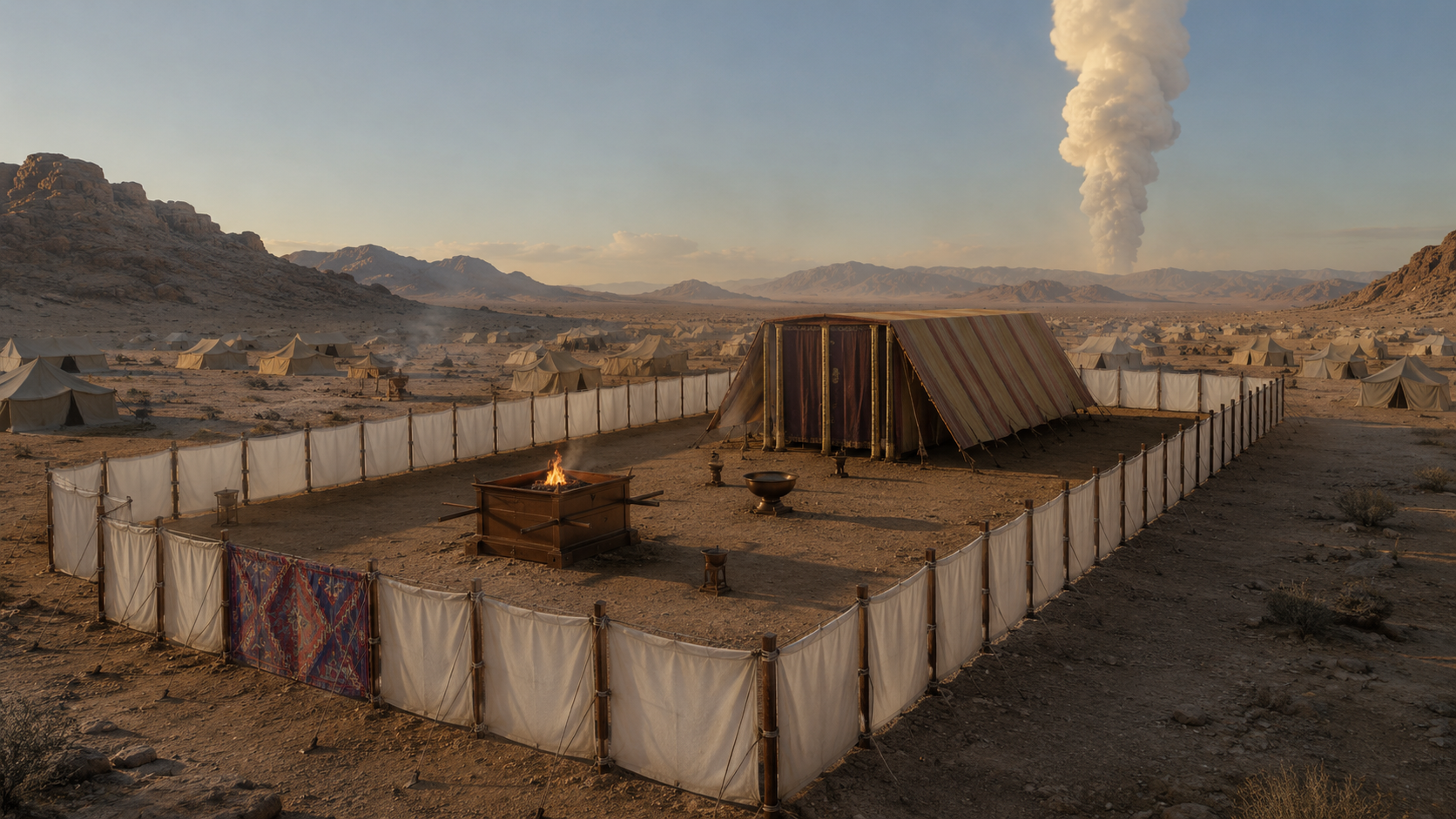
The Tabernacle introduces a third mode. Here sacred space is deliberately constructed. “Let them make me a sanctuary; that I may dwell among them,” the text declares, followed by detailed instructions concerning pattern, dimensions, materials, furnishings, access, priestly service, and repeated ceremony. The place is neither merely discovered nor arbitrarily invented. It is built in response to command and according to a pattern. The human community contributes labour, skill, material, administration, and obedience; the sanctuary’s authority is nevertheless said to derive from beyond the community itself. 6
Solomon’s dedication of the Temple then exposes the central paradox that will govern the next investigation. He has built a house for the Divine Name, yet he acknowledges that “the heaven and heaven of heavens” cannot contain God, much less the house he has built. The sacred building is necessary, but not because the Divine requires confinement. Its necessity must therefore arise from the human side of the relationship. 7
These texts do not produce a single mechanical definition of sacred space. They disclose several modes by which it comes into being: a place may be recognised after encounter, declared holy through command, marked by memorial action, deliberately constructed according to rule, and sustained through repeated practice. The categories of discovered and made are therefore not always opposites. A community may believe that it constructs because it has first received, and may preserve through ritual what it believes it did not originate.
The distinction is crucial for this manuscript. To say that human beings build sacred spaces is not to say that they fabricate the realities to which those spaces point. Nor is it to assume, without evidence, that every claim of divine encounter is objectively verified by the building erected around it. The intellectual task is to hold both propositions together: sacred architecture is undeniably a human construction, and its builders often understand that construction as a response to an order, presence, command, or truth not of their own making.
The Body at the Threshold
The sacred becomes spatially intelligible through the threshold. A threshold is physically small but conceptually immense. It is the line at which one condition ends and another begins: outside and inside, unprepared and prepared, unauthorised and admitted, ordinary time and ritual time. Because a threshold must be crossed by the body, it transforms an abstract distinction into an experienced one. The person does not merely think that a transition has occurred; he walks through it.
Arnold van Gennep’s classic analysis of rites of passage identified a recurring sequence of separation, transition, and incorporation. Later scholarship, particularly Victor Turner’s treatment of liminality, developed the middle condition in which an individual has left one status but has not yet been established in another. These theories have sometimes been applied too broadly, but their spatial insight remains powerful: transition requires a zone in which ordinary classifications are suspended, examined, or reconstituted. 8 Architecture gives this process a material form. Gates, porches, vestibules, steps, curtains, doors, screens, and intermediate chambers are not merely conveniences of circulation. They can slow entry, regulate access, heighten expectation, and make the act of crossing morally or psychologically consequential.
The body is indispensable here. Sacred traditions repeatedly employ bodily disciplines at the boundary: washing, removing footwear, changing garments, bowing, veiling, uncovering, silence, procession, circumambulation, or waiting. The point is not that these actions carry identical meanings in every tradition, they do not, however, the deeper point is that a transition of consciousness is reinforced by a transition of conduct. The body becomes the first instrument through which spatial distinction is learned.
This helps explain why ritual performed in an undifferentiated environment often loses force. A sentence spoken anywhere may remain true, but a ceremony depends upon sequence, relation, and setting. The same words delivered before entry, at a threshold, at a centre, or upon departure do not produce the same experience because their spatial position alters their function. Jonathan Z. Smith’s emphasis upon constructed ritual environments is important precisely for this reason: ritual action becomes intelligible through placement. 9
Architecture does more than surround the body; it choreographs it. The editors of Architecture of the Sacred describe buildings as active agents in the magnification, elevation, and ritualisation of action. Studies in that volume show how monumental steps could turn ascent into ceremony, how gateways could regulate what was revealed and when, how sight lines could order attention, and how movement through a sanctuary could bind architecture, memory, and ritual together. 10 None of this proves that architecture can manufacture faith. It demonstrates something more defensible: architecture can organise the conditions under which a community attends, moves, remembers, and acts.
Architecture as a Discipline of Attention
Human attention is limited, vulnerable, and easily dispersed. No civilisation has treated this as a minor problem. Education, law, worship, military discipline, theatre, and political assembly all develop techniques for concentrating attention and directing it toward a chosen object. The Sacred architecture belongs within this history, but it operates with unusual comprehensiveness because it coordinates space, movement, sound, light, memory, authority, and expectation at once.
A sacred building is therefore not just a container for ideas, but a technology of attention. The phrase should not be understood mechanically, as though human beings were passive devices manipulated by walls. It means that architecture can assist the mind in doing what it struggles to do unaided: withdraw from distraction, sustain focus, recognise sequence, experience proportion, and connect present action with inherited meaning. The enclosure removes some stimuli and amplifies others. The route of approach delays arrival, the center gathers the eye, height alters scale, silence makes small sounds consequential, repetition makes order perceptible and Light distinguishes what is revealed from what remains obscure.
Modern research provides cautious empirical support for the broader proposition that built form affects perception and affect. Studies in neuroarchitecture have investigated how interior geometry, curvature, enclosure, ceiling height, and other features correlate with aesthetic judgment, emotional response, approach-avoidance decisions, and patterns of brain activity. Banaei and colleagues, using mobile electroencephalography and virtual reality, found that participants’ brain dynamics varied as they walked through different interior forms. Vartanian and colleagues found that architectural contour influenced judgments of beauty and neural activity associated with affective processing. Coburn, Vartanian, and Chatterjee have argued for a more systematic neuroscience of architectural experience while warning that the field remains young and methodologically difficult. 11
These findings should not be inflated into metaphysics. A brain scan cannot identify holiness, prove transcendence, or demonstrate that a particular geometry awakens the soul. Claims of that kind would substitute scientific vocabulary for evidence. What the research does establish is more modest and more useful: the built environment is not psychologically inert. Human beings respond to spatial form, often before they can articulate the reasons for that response. Sacred architecture works with this fact, but its meaning does not arise from geometry alone. It arises from the convergence of form with narrative, ritual, memory, community, and conviction.
Stone by itself does not generate reverence as well as a darkened room does not automatically produce insight. A high ceiling does not create humility in every visitor, and symmetrical arrangement does not confer moral legitimacy upon the institution that occupies it. The same architectural techniques can be used to cultivate reflection, stage political power, intimidate the vulnerable, glorify authority, or sell commodities. Architecture intensifies; it does not guarantee the worth of what it intensifies.
This limitation is therefore essential. It prevents a serious theory of sacred space from collapsing into superstition about hidden energies or deterministic claims about form. The effect of sacred architecture is neither magical nor purely subjective. It is relational. A form becomes powerful when the body encounters it within an intelligible system of expectation and meaning. The building disciplines attention, but the tradition tells attention what is at stake.
The Spatial Grammar of the Sacred
Across different traditions, sacred places employ recurring architectural operations: they establish boundaries, mark thresholds, create focal centres, orient the body, regulate movement, manipulate light and sound, and connect present action with remembered time. These recurrences must not be mistaken for a universal code in which every direction, number, colour, or shape always carries the same meaning. Sacred architecture has a grammar, not a single dictionary. The same operation can serve different theologies, while similar beliefs can be expressed through different forms.
The boundary is the first operation because without distinction there can be no set-apart space. A wall, rope, screen, curtain, change of floor level, line of stones, or rule of access declares that conduct on one side is not identical to conduct on the other. Boundaries may protect concentration, preserve privacy, regulate initiation, distinguish roles, or defend an inner place from casual intrusion. They can also become instruments of exclusion, status, and domination. The moral meaning of a boundary therefore depends upon what it protects, whom it excludes, how authority is exercised, and whether the distinction serves truth or merely power.
The threshold makes the boundary traversable without abolishing it. It converts exclusion into ordered admission. A gate says that entrance is possible, but not meaningless. It establishes sequence and acknowledges that approach has conditions. Architectural studies of ancient sanctuaries show that gateways and monumental steps shaped ceremony by controlling pace, visibility, elevation, and the relationship between participants and spectators. 12 A threshold can therefore function as an argument: what lies within is not to be entered as though nothing has changed.
The centre gathers a dispersed field around a point of reference. It may be an altar, a tomb, a sacred text, a throne, an image, a void, a light, or the place from which authorised speech is delivered. Its function is not always geometrical. A focal centre may be spatially off-centre while remaining symbolically decisive. What matters is that bodies, sight lines, movement, and attention become coordinated around it. The centre establishes relation: near and far, before and behind, approach and withdrawal. It gives a community a visible answer to the question, “Around what are we assembled?”
Orientation extends that relation beyond the building itself. A structure may be aligned with a cardinal direction, a landscape feature, a celestial event, a burial place, a remembered city, or an inherited narrative. Not every sacred building faces East, and no responsible inquiry should pretend otherwise. The common principle is deliberate relation. Orientation refuses to treat the building as self-contained. It places human action within a larger world – geographical, historical, astronomical, or theological. The act of facing becomes an act of remembering what lies beyond the walls.
Procession turns spatial order into narrative. A person who moves through a sequence of spaces receives information in time: what is concealed, what is approached, what is circled, what is ascended, what is left behind, and what is finally revealed. The building is not apprehended at once; it unfolds. This temporal character is one reason sacred architecture can become formative. It requires patience. It denies the instant possession of the whole. The participant learns through ordered partiality.
Light and sound deepen this process because they govern revelation and presence without becoming material objects in the same way as walls or furniture. Controlled illumination can direct the eye, establish hierarchy, mark time, or allow a form to emerge gradually. Acoustics can enlarge a single voice, dissolve individual sound into communal response, or make silence itself perceptible. Again, there is no universal symbolism. Light may represent revelation in one context and destructive exposure in another; darkness may signify ignorance, mystery, gestation, grief, or protection. The architectural operation is the deliberate modulation of perception.
Proportion and repetition make order felt. Repeated columns, measured intervals, balanced masses, patterned floors, and rhythmic openings allow the body and eye to anticipate relation. Such coherence can produce calm, solemnity, or intelligibility, although individual and cultural responses vary. The important point is not that one sacred proportion has been secretly encoded across all civilisations. That claim has generated a great deal of pseudo-history. The defensible proposition is that proportion renders relation visible and that sacred builders have repeatedly used measured relation to distinguish intentional order from accidental accumulation.
Taken together, these operations show why sacred architecture cannot be reduced to decoration. It is a spatial constitution. It assigns positions, regulates access, establishes sequence, concentrates authority, preserves memory, and defines the relation between centre and perimeter. It is, in that sense, a form of governance before it is a style.
Memory, Authority, and the Possibility of Capture
Sacred space does not only organise bodies in the present; it governs relations with the past. Paul Connerton’s work on social memory distinguishes between knowledge preserved in texts and memory transmitted through commemorative ceremonies and bodily practices. Communities remember by doing, not merely by recording. Repeated movement, posture, recitation, and assembly can carry an inherited pattern across generations, while the building supplies a relatively stable stage upon which that pattern can be renewed. 13
This explains why sacred places often survive the persons who first made them meaningful. The founders die, but the threshold remains. The first witnesses disappear, but the route of approach is walked again. The original act is not reproduced perfectly – no repetition can recover the past without change – yet the place enables a community to stand where predecessors stood and to submit the present to an inherited measure. Architecture gives memory duration, while ritual gives architecture renewed life.
The process is powerful, but it is not innocent. Every sacred place preserves some memories more visibly than others. Every official route directs attention toward selected objects and away from others. Every authorised narrative answers the question of who founded, who suffered, who conquered, who belongs, who may speak, and who must remain at the perimeter. Sacred architecture can therefore become a mechanism by which authority presents its own history as natural, ancient, and immune from challenge.
This is where the question “sacred for whom?” becomes a governance test. Who possesses the authority to name the place, define its centre, control its threshold, interpret its symbols, and decide which memories are binding? What happens when the custodians confuse stewardship with ownership? What happens when procedure continues but legitimacy fails, when ceremonial continuity conceals moral disorder, or when the grandeur of a building is used to discourage scrutiny of the institution within it?
Sacredness must not become an exemption from accountability. A claim that a place is holy, venerable, traditional, or symbolically indispensable cannot by itself justify every rule imposed there. Architecture may dignify authority, but it cannot legitimise authority that has abandoned truth, justice, or the purpose for which the place was set apart. Indeed, the more powerful the symbolism, the greater the danger of capture. Forms capable of disciplining attention can also discipline dissent; ceremonies capable of transmitting wisdom can also make abuse appear inevitable; inherited language can become a veil behind which no one asks whether the institution still serves the order it professes.
The proper response is not iconoclasm. To destroy every inherited form because form can be misused would be to abandon memory, depth, and disciplined attention to the loudest forces of the present. The answer is stress-testing. A sacred institution must continually examine whether its boundaries protect purpose or merely privilege; whether its centre directs attention toward truth or toward office; whether its rituals form conscience or suspend it; whether its architecture invites moral ascent or only demands submission. The validity of the form is tested by the quality of life it produces beyond the form.
This principle will later become decisive for the Masonic Lodge. A Lodge may be arranged perfectly, its ritual performed flawlessly, and its officers placed correctly, yet none of those achievements alone proves that wisdom, justice, brotherly love, or integrity are present. Spatial order is a proposition. Conduct is the evidence.
The Masonic Threshold
Only now is it useful to introduce Freemasonry, and yes, the delay is deliberate. If the Lodge is examined first, every feature is likely to be explained by inherited Masonic vocabulary before the deeper human problem has been seen. Once sacred space has been understood as a disciplined relation among boundary, movement, memory, authority, and attention, the Lodge can be approached with a more exact question: what kind of place is it, and what work is its order intended to perform?
Under the United Grand Lodge of England, Freemasonry is not a religion and does not claim a religious affiliation. UGLE describes it as a social and charitable organisation rooted in the traditions of medieval stonemasons, using building analogies to teach members how to lead productive lives and benefit their communities. Its ceremonial traditions are intended to encourage moral reflection, tolerance, responsibility, and the practice of Integrity, Friendship, Respect, and Service. 14 This institutional boundary matters. A Masonic Lodge room must not be carelessly equated with a church, mosque, synagogue, or theological sanctuary, nor should Masonic symbolism be presented as a substitute revelation.
At the same time, UGLE itself describes the Lodge room as thoughtfully arranged, with designated positions for officers and ceremonies structured as stages in a candidate’s moral and reflective journey. The Worshipful Master is placed in the East, the Senior Warden in the West, and the Junior Warden in the South; candidates are guided through ceremonies in which movement, position, speech, and symbolism are deliberately coordinated. 15 The Lodge room therefore shares important formal characteristics with sacred architecture without becoming identical to it. It is bounded, ordered, oriented, governed, symbolically furnished, and activated through repeated ceremonial action.
The distinction can be stated precisely. The Lodge room is not sacred because hidden forces are presumed to inhabit its walls. It becomes a set-apart Masonic environment because an authorised body assembles there, orders the space, opens its proceedings according to rule, performs recognised ceremonies, and submits individual movement and speech to a shared form. Its power lies not in occult energy but in concentrated relation. Architecture, ritual, memory, and moral expectation are made to act together.
This is also why a Lodge cannot be understood by inventory alone. A list of furniture and symbols would not disclose the whole. The arrangement matters; the authorised relationships matter; the sequence matters; the conduct of the brethren matters. The Lodge is not a museum of emblems but a governed field of action. If its symbols are removed from relationship, they become decorative. If its ritual is removed from moral labour, it becomes theatre. If its hierarchy is removed from service, it becomes rank. The set-apart space fulfils its purpose only when the order displayed within it becomes a measure for conduct beyond it.
English Masonic caution against confusing Freemasonry with religion therefore strengthens rather than weakens this investigation. It forces a disciplined distinction between theological sacredness and symbolic set-apartness. The Lodge need not be declared a house of God in order to function as a place where ordinary habits are interrupted, attention is concentrated, moral relationships are dramatised, and the candidate is invited to see himself and his obligations differently. The decisive question is not whether the Lodge is secretly a temple. It is why the Lodge requires the architecture of set-apart space in order to teach what it teaches.
Resolution: Why We Build
Human beings build sacred spaces because consciousness requires orientation, memory requires embodiment, ritual requires placement, and communities require visible forms through which invisible obligations can be renewed. We build because attention is finite and must be gathered; because inherited truths fade when they possess no durable setting; because transition is better understood when it is walked; because the body learns distinctions that the intellect alone may evade; and because a community cannot sustain a common moral world without repeatedly making that world perceptible.
Yet none of these functions proves that every sacred building is true, every inherited ritual legitimate, or every authority entitled to obedience. Sacred space magnifies. It can magnify wisdom or error, humility or domination, memory or mythology, service or capture. The form therefore requires judgment. A place justifies its set-apart character not merely by age, beauty, secrecy, or institutional assertion, but by the truth it serves, the quality of attention it cultivates, the dignity with which it treats those who cross its threshold, and the conduct it produces when they leave.
The deepest reason for building is thus neither shelter nor spectacle. It is the human need to make order inhabitable. Sacred architecture takes a claim about reality and gives that claim a boundary, a centre, a path, a rhythm, and a memory. It allows an invisible order to be encountered through visible relation. That act may begin in revelation, tradition, political authority, communal memory, or philosophical conviction, but it always reaches the body through place.
We are now prepared for the harder question. If sacred architecture exists to make an order perceptible, what order does the biblical Temple claim to embody? Solomon himself denied that the Divine could be contained by any house. Why, then, did Israel build one, and why did that building become the central architectural memory inherited by the Craft?
The next investigation begins with Solomon’s paradox:
“But will God indeed dwell on the earth? behold, the heaven and heaven of heavens cannot contain thee; how much less this house that I have builded?“
If God cannot be contained, why build a Temple?
Notes and References
1. Yi-Fu Tuan, Space and Place: The Perspective of Experience (Minneapolis: University of Minnesota Press, 2001; first published 1977), especially 3-18. Tuan’s foundational study examines how undifferentiated space becomes place through experience, value, attachment, and time.
2. Jonathan Z. Smith, To Take Place: Toward Theory in Ritual (Chicago: University of Chicago Press, 1987); Jonathan Z. Smith, Imagining Religion: From Babylon to Jonestown (Chicago: University of Chicago Press, 1982), 55. Smith emphasises constructed ritual environments and treats sacred/profane distinctions as situational and relational rather than inherent substances.
3. Matt Tomlinson and Yujie Zhu, Making Places Sacred: New Articulations of Place and Power (Cambridge: Cambridge University Press, 2025), doi:10.1017/9781009616355. See also Belden C. Lane, ‘Giving Voice to Place: Three Models for Understanding American Sacred Space,’ Religion and American Culture 11, no. 1 (2001): 53-81.
4. Genesis 28:10-22, especially 28:16-19, Authorized King James Version. Jacob recognises the place, marks the stone, anoints it, and renames the location Bethel.
5. Exodus 3:1-6, especially 3:5, Authorized King James Version.
6. Exodus 25:8-9, 25:40, and chapters 25-31; 35-40, Authorized King James Version.
7. 1 Kings 8:27, Authorized King James Version; compare Isaiah 66:1 and Acts 7:48-50.
8. Arnold van Gennep, The Rites of Passage, trans. Monika B. Vizedom and Gabrielle L. Caffee, 2nd ed. (Chicago: University of Chicago Press, 2019; English translation first published 1960), 10-11; Victor Turner, The Ritual Process: Structure and Anti-Structure (Chicago: Aldine, 1969), 94-130.
9. Smith, To Take Place, particularly his argument that ritual action becomes intelligible through placement within a constructed environment.
10. Bonna D. Wescoat and Robert G. Ousterhout, eds., Architecture of the Sacred: Space, Ritual, and Experience from Classical Greece to Byzantium (Cambridge: Cambridge University Press, 2012), xxi-xxiv; Mary B. Hollinshead, ‘Monumental Steps and the Shaping of Ceremony,’ in the same volume, 27-65; Margaret M. Miles, ‘Entering Demeter’s Gateway: The Roman Propylon in the City Eleusinion,’ 114-151.
11. Mehrdad Banaei, Javad Hatami, Ali Yazdanfar, and Klaus Gramann, ‘Walking through Architectural Spaces: The Impact of Interior Forms on Human Brain Dynamics,’ Frontiers in Human Neuroscience 11 (2017): 477, doi:10.3389/fnhum.2017.00477; Oshin Vartanian et al., ‘Impact of Contour on Aesthetic Judgments and Approach-Avoidance Decisions in Architecture,’ Proceedings of the National Academy of Sciences 110, no. 26 (2013): 10446-10453, doi:10.1073/pnas.1301227110; Alex Coburn, Oshin Vartanian, and Anjan Chatterjee, ‘Buildings, Beauty, and the Brain: A Neuroscience of Architectural Experience,’ Journal of Cognitive Neuroscience 29, no. 9 (2017): 1521-1531, doi:10.1162/jocn_a_01146.
12. Hollinshead, ‘Monumental Steps and the Shaping of Ceremony,’ 27-65; Miles, ‘Entering Demeter’s Gateway,’ 114-151; Wescoat and Ousterhout, Architecture of the Sacred.
13. Paul Connerton, How Societies Remember (Cambridge: Cambridge University Press, 1989), especially 41-104. Connerton analyses commemorative ceremonies and bodily practices as means by which social memory is transmitted.
14. United Grand Lodge of England, ‘What is Freemasonry?’ accessed 30 July 2026; United Grand Lodge of England, ‘Freemasonry FAQs,’ accessed 30 July 2026; United Grand Lodge of England, Information for the Guidance of Members of the Craft (London: UGLE, current online edition), 44. UGLE states that Freemasonry has no religious affiliation and expressly cautions against blurring the line between Freemasonry and religion.
15. United Grand Lodge of England, ‘Exploring Freemasonry: What is a Lodge and Its Officers?’ 12 February 2025, accessed 30 July 2026. The official UGLE account describes the Lodge room as deliberately arranged and identifies the principal officers’ positions in the East, West, and South.
Selected Bibliography
Banaei, Mehrdad, Javad Hatami, Ali Yazdanfar, and Klaus Gramann. ‘Walking through Architectural Spaces: The Impact of Interior Forms on Human Brain Dynamics.’ Frontiers in Human Neuroscience 11 (2017): 477.
Coburn, Alex, Oshin Vartanian, and Anjan Chatterjee. ‘Buildings, Beauty, and the Brain: A Neuroscience of Architectural Experience.’ Journal of Cognitive Neuroscience 29, no. 9 (2017): 1521-1531.
Connerton, Paul. How Societies Remember. Cambridge: Cambridge University Press, 1989.
Lane, Belden C. ‘Giving Voice to Place: Three Models for Understanding American Sacred Space.’ Religion and American Culture 11, no. 1 (2001): 53-81.
Smith, Jonathan Z. Imagining Religion: From Babylon to Jonestown. Chicago: University of Chicago Press, 1982.
Smith, Jonathan Z. To Take Place: Toward Theory in Ritual. Chicago: University of Chicago Press, 1987.
Tomlinson, Matt, and Yujie Zhu. Making Places Sacred: New Articulations of Place and Power. Cambridge: Cambridge University Press, 2025.
Tuan, Yi-Fu. Space and Place: The Perspective of Experience. Minneapolis: University of Minnesota Press, 2001.
Turner, Victor. The Ritual Process: Structure and Anti-Structure. Chicago: Aldine, 1969.
United Grand Lodge of England. Information for the Guidance of Members of the Craft. London: UGLE, current online edition.
United Grand Lodge of England. ‘Exploring Freemasonry: What is a Lodge and Its Officers?’ 12 February 2025.
United Grand Lodge of England. ‘Freemasonry FAQs.’ Accessed 30 July 2026.
United Grand Lodge of England. ‘What is Freemasonry?’ Accessed 30 July 2026.
Van Gennep, Arnold. The Rites of Passage. Translated by Monika B. Vizedom and Gabrielle L. Caffee. 2nd ed. Chicago: University of Chicago Press, 2019.
Vartanian, Oshin, et al. ‘Impact of Contour on Aesthetic Judgments and Approach-Avoidance Decisions in Architecture.’ Proceedings of the National Academy of Sciences 110, no. 26 (2013): 10446-10453.
Wescoat, Bonna D., and Robert G. Ousterhout, eds. Architecture of the Sacred: Space, Ritual, and Experience from Classical Greece to Byzantium. Cambridge: Cambridge University Press, 2012.
The Holy Bible. Authorized King James Version.
Leave a Reply