


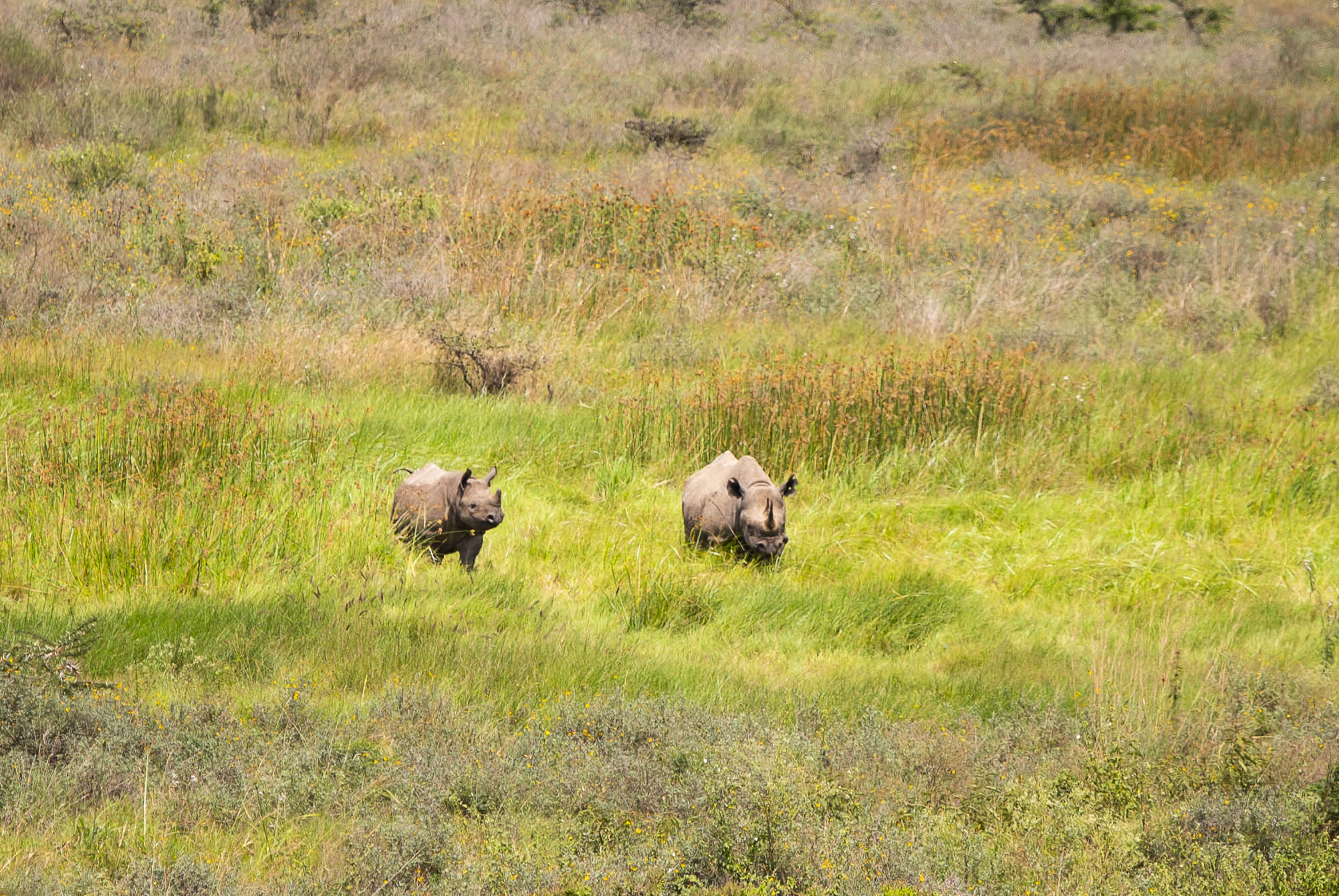
While attending the Africa Internet Summit 2026 in Kenya, I saw these rhinos from my 9th-floor balcony at the Emara Ole-Sereni Hotel. It was one of those moments where the image carried more meaning than the scene itself.
Two rhinos moving through the grass, powerful but alert, ancient yet vulnerable, independent yet bound to the ecosystem around them.
For me, this became a metaphor for the Internet in Africa.
The rhino is a symbol of strength, but strength alone does not preserve it. It survives through territory, instinct, adaptation, protection, and a deep understanding of its environment. It does not exist outside the pressures around it. It must navigate danger, preserve space, protect continuity, and depend on an ecosystem that must also remain healthy.
Africa’s Internet is in a similar moment.
Across the continent, we are building networks in difficult terrain: high infrastructure costs, power instability, expensive upstream capacity, weak enforcement of infrastructure protection, spectrum congestion, limited access to capital, and digital markets where users need better connectivity but cannot always afford the true cost of building it.
Yet the story of Africa’s Internet is not only a story of gaps. It is also a story of resilience, engineering, policy evolution, local innovation, and operators who continue to build despite the constraints.
The next phase of Africa’s Internet cannot be measured only by whether people are connected. It must be measured by the quality, resilience, affordability, and sovereignty of that connection.
Do we keep traffic local?
Do we build stronger Internet Exchange Points beyond the major coastal and capital cities?
Do we bring content, cloud, and caches closer to users?
Do we deploy IPv6 seriously, secure our routing, monitor our networks properly, and protect critical infrastructure?
Do our policies create real outcomes, or do they remain trapped in conferences, communiqués, and ceremonial commitments?
At the Africa Internet Summit, these questions were not abstract. They were present in discussions about Internet governance, interconnection, infrastructure, IPv6, cybersecurity, content delivery, and the future of African digital cooperation.
The rhino teaches one important lesson: survival is not passive.
A rhino preserves its existence by knowing its terrain, defending its space, reading danger early, and avoiding unnecessary conflict while remaining capable of force when survival demands it. African Internet infrastructure must learn the same discipline.
We need networks that are not only connected and secured, but resilient. Equally, we need operators who compete commercially but cooperate technically, as well as regulators who do more than license infrastructure; they must protect it.
We need governments that understand that digital transformation is not built by slogans, but by fiber routes, exchange points, management systems, power systems, data centers, local content, skilled engineers, enforceable policy, and long-term investment.
We need an African Internet that is less dependent, more interconnected, more local, and more capable of defending its own continuity.
The future of the Internet in Africa will not be shaped only by global platforms, submarine cables, or imported models. It will be shaped by whether African operators, policymakers, engineers, investors, and institutions can build an ecosystem strong enough to carry Africa’s own digital ambitions.
Connectivity gave us entry, resilience will give us dignity, and Local interconnection will give us power.
The future will belong to those who understand that the Internet, like the rhino, survives not by appearance alone, but by territory, protection, adaptation, and the strength of the ecosystem around it.
Leave a Reply